Medical Software Development · Dubai & UAE
Healthcare Software Development in the UAE
A healthcare software development company for hospitals, clinics, private practices and home care providers in Dubai, Abu Dhabi and across the Emirates - built to UAE health data law, interoperable with your EHR and your emirate’s health information exchange, and deployed without interrupting patient care.
Client success
Trusted by innovators
Don't just take our word for it. Here's what our partners say about our straightforward approach and dedication to their success.
No miscommunication, no surprises - clear outlines from day one and genuine support throughout. Exactly what we needed.
Private project
Bookkeeping & Order Management Software

Stunning website for our vacation home plus marketing materials that actually convert - social posts, physical fliers, the full package.
Vladimirovs House
Vacation Home Website

They took us online for the first time and our client portfolio grew immediately. Even threw in social media content as a bonus.
D.M. Security
Security Services Company Website

After months of searching for the right team, WDF nailed our vision on the first attempt. Couldn't be more satisfied with the result.
LUMIÈRE Joaillerie
3D Jewellery E-Commerce shop, Full Stack
No miscommunication, no surprises - clear outlines from day one and genuine support throughout. Exactly what we needed.
Private project
Bookkeeping & Order Management Software
Stunning website for our vacation home plus marketing materials that actually convert - social posts, physical fliers, the full package.
Vladimirovs House
Vacation Home Website
They took us online for the first time and our client portfolio grew immediately. Even threw in social media content as a bonus.
D.M. Security
Security Services Company Website
After months of searching for the right team, WDF nailed our vision on the first attempt. Couldn't be more satisfied with the result.
LUMIÈRE Joaillerie
3D Jewellery E-Commerce shop, Full Stack
No miscommunication, no surprises - clear outlines from day one and genuine support throughout. Exactly what we needed.
Private project
Bookkeeping & Order Management Software
Stunning website for our vacation home plus marketing materials that actually convert - social posts, physical fliers, the full package.
Vladimirovs House
Vacation Home Website
They took us online for the first time and our client portfolio grew immediately. Even threw in social media content as a bonus.
D.M. Security
Security Services Company Website
After months of searching for the right team, WDF nailed our vision on the first attempt. Couldn't be more satisfied with the result.
LUMIÈRE Joaillerie
3D Jewellery E-Commerce shop, Full Stack
No miscommunication, no surprises - clear outlines from day one and genuine support throughout. Exactly what we needed.
Private project
Bookkeeping & Order Management Software
Stunning website for our vacation home plus marketing materials that actually convert - social posts, physical fliers, the full package.
Vladimirovs House
Vacation Home Website
They took us online for the first time and our client portfolio grew immediately. Even threw in social media content as a bonus.
D.M. Security
Security Services Company Website
After months of searching for the right team, WDF nailed our vision on the first attempt. Couldn't be more satisfied with the result.
LUMIÈRE Joaillerie
3D Jewellery E-Commerce shop, Full Stack
The problem
Healthcare software fails in predictable ways
Rarely because of the technology. Almost always because the build did not account for how clinical work really happens - or for what an auditor will ask for later.
Clinicians working around the software
When a system fights the clinical workflow, staff route around it - paper notes, side spreadsheets, verbal handovers. The record stops being the record, and that is a patient safety issue long before it is an IT one.
Systems that will not talk to each other
The EHR, the lab system, the imaging archive and the billing platform each hold part of the picture. Staff become the integration layer, retyping the same patient data three times.
Compliance bolted on at the end
Encryption, audit logging and access control retrofitted late are expensive, incomplete and hard to evidence. Auditors ask for proof, not intentions.
Vendors who do not understand clinical reality
Generic development teams build what the spec says. They miss the triage exception, the after-hours workflow and the fact that a two-second delay at the bedside is unacceptable.
Healthcare-grade engineering
Healthcare software development services, built to the standards care demands
Medical software is infrastructure that affects patient outcomes. Our practices are built around the regulatory, security and interoperability requirements that come with that.
UAE Health Data Architecture
Built from the ground up for UAE health data law - hosted inside the UAE, AES-256 at rest, TLS 1.3 in transit, role-based access and an immutable log of every access to patient data. Where US patient data is involved, the same design meets the HIPAA Security Rule’s technical safeguards.
- Hosted in the UAE
- Encryption at rest and in transit
- Audit log of every access
Custom EHR & EMR Development
Extending a certified EHR where that is the cheaper answer, and building custom electronic health records software where it is not. Migration off an ill-fitting system without a gap in the patient record.
- Extend, integrate or replace
- Data migration without downtime
- Custom clinical workflows
HL7 & FHIR Interoperability
Native HL7 v2/v3 and FHIR R4 interfaces so your platform exchanges clean, coded clinical data with your EHR, laboratory and imaging systems - and, through your EHR, with NABIDH, Malaffi or Riayati.
- HL7 v2/v3 interfaces
- FHIR R4 resources
- Lab and imaging integration
Clinical Data Governance
Structured pipelines with lineage tracking, automated PHI de-identification, consent management and complete audit trails that satisfy both regulatory auditors and your compliance team.
- PHI de-identification
- Consent management
- End-to-end audit trails
Medical Device Software (IEC 62304)
For software classified as a medical device, we follow IEC 62304 lifecycle processes and ISO 14971 risk management, and keep the design-history documentation a regulator will ask for.
- IEC 62304 lifecycle
- ISO 14971 risk management
- Design history file
Telehealth & Remote Monitoring
Compliant video consultation, remote patient monitoring and chronic care management, integrated with the record rather than bolted alongside it.
- Compliant video consultation
- Remote patient monitoring
- Integrated e-prescribing
Patient Portals & Engagement
Self-service access to scheduling, records, results, secure messaging and billing - reducing inbound call volume while improving how informed patients arrive.
- Scheduling and records access
- Secure messaging
- Billing and payments
Building for the UAE
Three rules that shape healthcare software here
A clinical system built for a US or European market rarely drops into a UAE facility unchanged. These decide the architecture before the first screen is designed.
Health data stays in the UAE
Federal Law No. 2 of 2019 on the use of ICT in health fields requires health data from services provided in the UAE to be stored and processed inside the country unless an exception applies. That decides where the system is hosted before anything else is designed.
Each emirate has its health information exchange
DHA-licensed facilities exchange records through NABIDH, DoH-licensed facilities in Abu Dhabi through Malaffi, and MOHAP-licensed facilities in the Northern Emirates through Riayati. Facilities usually connect through their EHR, so what your systems feed the EHR has to be complete and coded.
Abu Dhabi adds its own security standard
Entities that generate, store or transmit health information in Abu Dhabi must meet the Department of Health’s Abu Dhabi Healthcare Information and Cyber Security Standard. Its controls are easier to design in than to retrofit.
Working with US patient data? We build to the HIPAA Security Rule as well, and sign a Business Associate Agreement where one applies.
Weighing a build, an integration or a replacement? Start with discovery.
Tell us how care actually flows through your organisation today. We will map where the software is costing clinical time and what the compliance path looks like - before any commitment.
What changes
Better care delivery, not just better software
The outcomes that justify the investment are clinical and operational, not technical.
Time given back to clinicians
Fewer clicks, fewer logins and fewer duplicate entries at the point of care - the administrative load that drives burnout.
One accurate patient record
Integration replaces retyping, so the record reflects reality across every department that touches the patient.
Compliance you can evidence
Audit trails, access logs and documentation produced continuously - so an audit is a report, not a scramble.
Capacity without new headcount
Automating scheduling, intake, reminders and reporting lets existing teams handle more patients safely.
Better patient experience
Self-service access and clear communication reduce call volume and no-shows while improving satisfaction.
Operational visibility
Live dashboards on flow, occupancy, turnaround times and care gaps - decisions made on today’s numbers.
Our work
Platforms we have delivered
A look inside the medical platforms, integrations and clinical tools we have built for healthcare organisations.
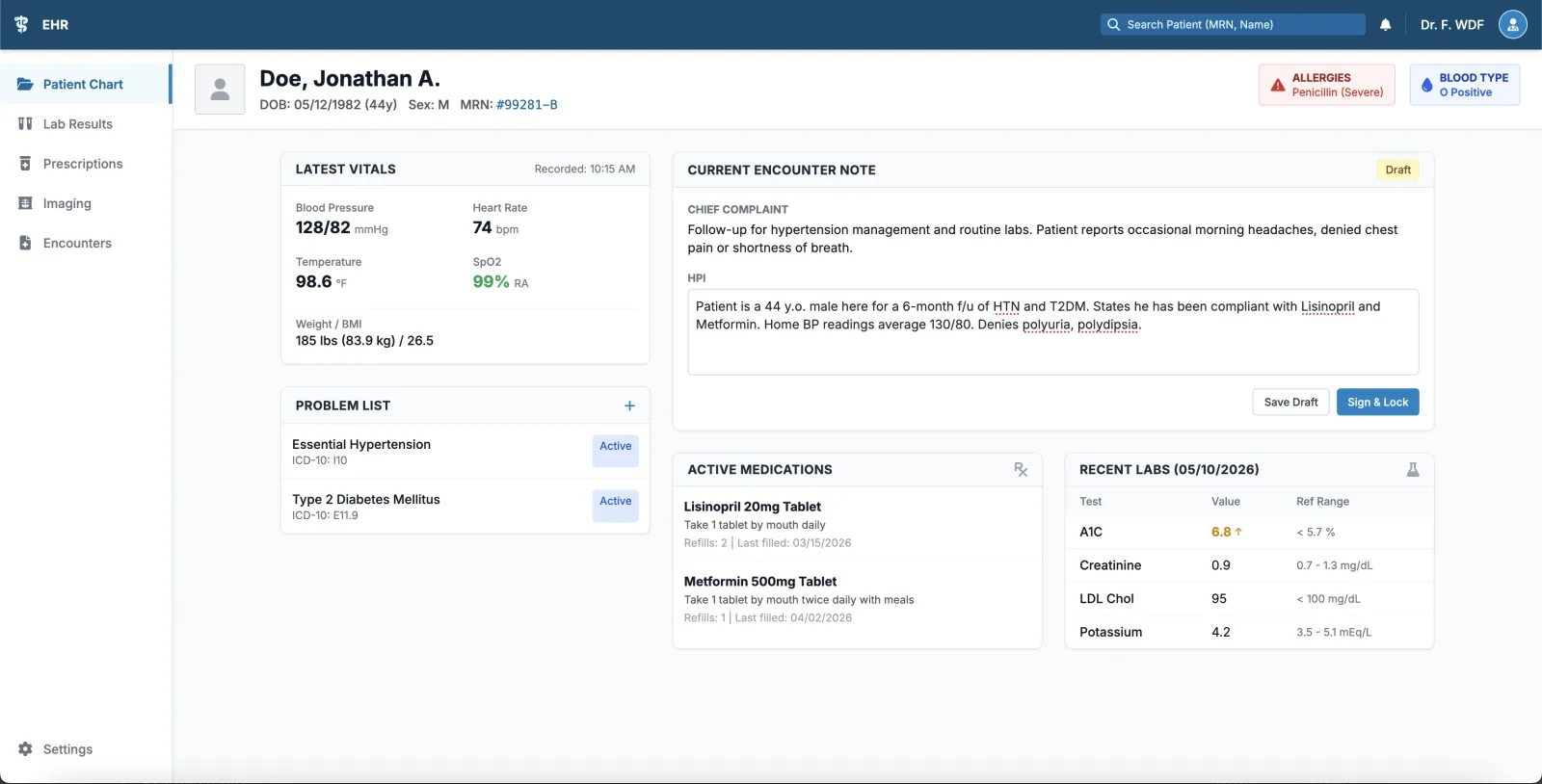
EHR Dashboard:A unified command center for clinician workflows, patient vitals and scheduling.
Project in focus
Clinical Operations Suite
A clinic management platform that centralises patient flow, departmental workflows, inventory logistics and staff coordination. It replaced disconnected legacy systems with one command centre - live operational visibility and automated supply reordering.
- Command center
- Patient records
- Staff management
- Live monitoring
This is a slice of the work. The full portfolio has the rest.
View all projectsSpecialty areas
Deep domain expertise across healthcare technology
Clinical Platforms
Clinic management, patient flow orchestration and departmental coordination systems.
Lab & Diagnostics
LIMS, specimen tracking, result reporting and lab-to-physician data pipelines.
Telehealth & RPM
Compliant video consultation, remote monitoring and chronic care management.
Patient Portals
Self-service scheduling, records access, secure messaging and billing.
EHR/EMR Integration
Middleware and API layers bridging clinical data across disparate legacy systems.
Population Health
Care gap analysis, cohort identification and value-based care reporting.
Who we build for
Hospitals, clinics, practices and home care
“Healthcare” hides four quite different buying situations. What you need depends more on the shape of your organisation than on your specialty.
Hospitals & multi-site groups
The problem is rarely a missing feature - it is eight systems holding overlapping copies of the same patient. Integration, a unified operational view, and department-level tooling the central EHR cannot economically provide. Clinical staffing and rostering is a recurring gap.
Clinics & outpatient practices
The bottleneck is administrative load per clinician. Intake, insurance verification, recall and reminders, and a patient portal people actually use. The highest return per dirham spent of any category, because the workflows are well understood and the integrations are few.
Private & specialty practices
Usually one thing done extremely well - treatment planning, progress tracking against device or wearable data, outcome measurement. A narrow, deep tool beats a broad one here almost every time.
Home care & community providers
Offline-capable mobile apps, visit verification, scheduling across a distributed workforce, and coordination between people who are never in the same building. Very poorly served by clinic-shaped software.
Three projects all get called “custom EHR development”
And they differ in cost by roughly tenfold, so it is worth being precise before anyone estimates anything.
- Extending a certified EHR. You keep the system of record and build what it does badly - intake, scheduling, a portal, a specialty module - exchanging data through its API or through HL7 FHIR. The right answer for most organisations, and the cheapest by a wide margin.
- A purpose-built system alongside it. Clinical staffing, home care visit verification, a device data pipeline, a research workflow. It integrates with the EHR without trying to be one. Usually the fastest payback, because nothing is currently doing the job.
- Replacing the EHR outright. Justified when your requirements are genuinely unusual, when you are building a product to sell to other providers, or when no certified platform fits your regulatory position. A multi-year commitment - we will say so plainly if that is what you are describing.
If your software influences diagnosis or treatment it may itself be regulated as a medical device; the FDA’s Software as a Medical Device guidance is where that question gets settled, and settling it in week one is far cheaper than in month nine.
How it works
Our clinical process
Building medical software takes more than technical skill - it takes clinical empathy and regulatory rigour, applied in that order.
Clinical discovery
We embed with your clinical and IT teams to map patient workflows as they really run, identify where current systems hurt, and define measurable improvement targets.
Regulatory & architecture planning
A compliance blueprint drafted alongside the system architecture - data flows, encryption strategy, integration points and risk assessments, agreed before development starts.
Iterative development
Two-week clinical sprints with continuous clinician feedback. Each increment ships with unit and integration tests against real-world scenarios.
Validation & deployment
Comprehensive validation testing, penetration testing and staged rollout with on-site support, so nothing disrupts patient care.
Support & evolution
Post-launch monitoring, compliance maintenance and an ongoing backlog as regulations, integrations and clinical practice change.

Part of a wider operations practice
Clinical systems sit alongside scheduling, inventory and finance. See our custom operations software service for the rest of the picture.
Still deciding whether to build?
Read our custom EHR development buyer’s guide - when a custom EHR is worth building, when extending one beats replacing it, and how to evaluate a vendor.
Proof of work
See the platforms behind the compliance
Clinical systems, operations platforms and the integrations that connect them. Browse the full portfolio and the problems each project set out to solve.
Check our workWeb & mobile
Customer-facing products built to convert
Operations
Internal platforms replacing spreadsheets
AI systems
Automation wired into real workflows
Embedded
Firmware and connected devices in the field
Why WDF
Why healthcare teams choose us
We do not just write code - we understand the clinical context it operates in, and the regulatory weight it has to carry.
Clinical-first engineering
Our team includes engineers who have worked inside hospital IT and understand the operational realities of a clinical environment, not just the specification.
Regulatory confidence
From UAE health data law and ADHICS to HIPAA and medical device classification, we carry the compliance complexity so your team can stay focused on patient care.
Interoperability as a default
HL7 and FHIR are not an add-on module. We assume from day one that your data has to move between systems safely.
Full ownership and IP
You own 100% of the source code, documentation and design files. No vendor lock-in and no recurring platform fee.
Deployed without disrupting care
Phased rollout, parallel running and on-site support during cutover, because clinical operations cannot pause for a go-live.
UAE health data rules by design
Hosting, access and audit built in, not retrofitted.
Full IP ownership
Source, documentation and design files are yours.
Audit-ready records
Design history and test evidence produced as you go.
Reply within 24 hours
A real engineer, usually much sooner.
Common questions
Medical software questions, answered
What clinical and IT leaders ask us most before starting a healthcare software project.
Compliance is designed in, not audited on. Federal Law No. 2 of 2019 requires health data from services provided in the UAE to be stored and processed inside the country unless an exception applies, so the system is hosted in the UAE from the start. Every build adds AES-256 encryption at rest, TLS 1.3 in transit, role-based least-privilege access and an immutable log of every access to patient data, and for entities in Abu Dhabi the controls of the Department of Health’s ADHICS standard. We produce the documentation and test evidence alongside the software, so you can demonstrate compliance rather than assert it.
Something not covered here?
Ready to build your medical platform?
Tell us about the clinical workflow you need to support. You will get an honest read on scope, compliance path and timeline before any commitment.
Prefer to talk directly?
Built to UAE health data rules. Full IP ownership. Deployed without disrupting care.
