Embedded Systems & IoT
Embedded Systems
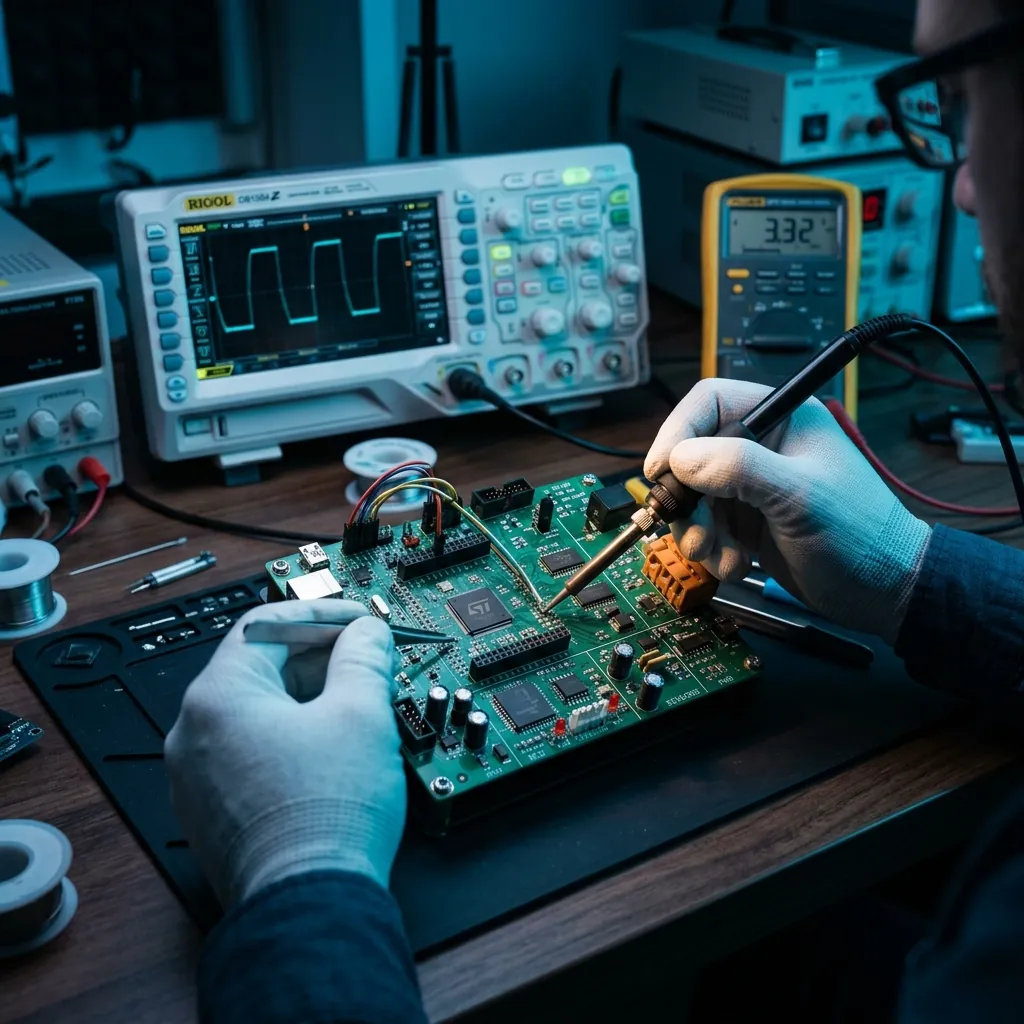
Firmware that gets your product out of the lab and into the field - reliable under real conditions, updatable once it ships, and documented well enough that your own team could take it over tomorrow.
Client success
Trusted by innovators
Don't just take our word for it. Here's what our partners say about our straightforward approach and dedication to their success.
No miscommunication, no surprises - clear outlines from day one and genuine support throughout. Exactly what we needed.
Private project
Bookkeeping & Order Management Software

Stunning website for our vacation home plus marketing materials that actually convert - social posts, physical fliers, the full package.
Vladimirovs House
Vacation Home Website

They took us online for the first time and our client portfolio grew immediately. Even threw in social media content as a bonus.
D.M. Security
Security Services Company Website

After months of searching for the right team, WDF nailed our vision on the first attempt. Couldn't be more satisfied with the result.
LUMIÈRE Joaillerie
3D Jewellery E-Commerce shop, Full Stack
No miscommunication, no surprises - clear outlines from day one and genuine support throughout. Exactly what we needed.
Private project
Bookkeeping & Order Management Software
Stunning website for our vacation home plus marketing materials that actually convert - social posts, physical fliers, the full package.
Vladimirovs House
Vacation Home Website
They took us online for the first time and our client portfolio grew immediately. Even threw in social media content as a bonus.
D.M. Security
Security Services Company Website
After months of searching for the right team, WDF nailed our vision on the first attempt. Couldn't be more satisfied with the result.
LUMIÈRE Joaillerie
3D Jewellery E-Commerce shop, Full Stack
No miscommunication, no surprises - clear outlines from day one and genuine support throughout. Exactly what we needed.
Private project
Bookkeeping & Order Management Software
Stunning website for our vacation home plus marketing materials that actually convert - social posts, physical fliers, the full package.
Vladimirovs House
Vacation Home Website
They took us online for the first time and our client portfolio grew immediately. Even threw in social media content as a bonus.
D.M. Security
Security Services Company Website
After months of searching for the right team, WDF nailed our vision on the first attempt. Couldn't be more satisfied with the result.
LUMIÈRE Joaillerie
3D Jewellery E-Commerce shop, Full Stack
No miscommunication, no surprises - clear outlines from day one and genuine support throughout. Exactly what we needed.
Private project
Bookkeeping & Order Management Software
Stunning website for our vacation home plus marketing materials that actually convert - social posts, physical fliers, the full package.
Vladimirovs House
Vacation Home Website
They took us online for the first time and our client portfolio grew immediately. Even threw in social media content as a bonus.
D.M. Security
Security Services Company Website
After months of searching for the right team, WDF nailed our vision on the first attempt. Couldn't be more satisfied with the result.
LUMIÈRE Joaillerie
3D Jewellery E-Commerce shop, Full Stack
The problem
Hardware slips when firmware is an afterthought
Embedded products rarely fail on the silicon. They fail on schedule, in the field, or at certification - and the cause is usually a decision made early in the software.
The hardware works. The software is the bottleneck.
The board is finished, the enclosure is tooled, and the product cannot ship because the firmware is unstable, the drivers are half written, or nobody can reproduce the field failure.
Devices in the field you cannot reach
Without reliable over-the-air updates, every fix becomes a truck roll or an RMA. A single security patch turns into a logistics project.
Timing that fails under real load
It works on the bench and misses deadlines in production. Without a real-time architecture, latency problems appear exactly when the device is busiest.
A prototype that will not survive manufacturing
Code written to prove a concept rarely handles brownouts, flash wear, certification requirements or a decade in the field. Rewriting it late is the expensive path.
Our engineering expertise
Software that performs where conditions are hostile
Constrained memory, tight power budgets, unreliable networks and hard deadlines - the environment embedded software actually lives in.
Robotics & AMR Integration
Getting autonomous mobile robots to work with the systems you already run - fleet orchestration, task allocation, and the WMS and ERP interfaces between them. VDA 5050 where the fleet needs to stay multi-vendor.
- AMR fleet orchestration
- WMS and ERP integration
- VDA 5050 interfaces
IoT Solutions
Connected devices that talk to the cloud reliably and securely - including on flaky networks, where the hard part is what happens when the connection drops.
- Sensor integration
- Cloud telemetry pipelines
- Secure MQTT / CoAP
Firmware Development
Optimised C and C++ written for your specific microcontroller, tuned for the two constraints that decide product viability: power draw and memory footprint.
- Bare-metal & RTOS
- Power optimisation
- Bootloaders and OTA
Real-Time Systems
Deterministic behaviour for applications where a missed deadline is a failure, not a slowdown - motion control, safety interlocks, industrial automation.
- RTOS architecture
- Deterministic scheduling
- Watchdogs and fail-safes
Hardware Integration
Peripheral drivers, board bring-up and the low-level plumbing that makes a custom PCB behave like a finished product rather than a dev kit.
- Driver development
- SPI / I2C / UART / CAN
- Sensor and actuator control
OTA & Fleet Management
Update infrastructure that lets you ship fixes and features to devices already in customers’ hands, with staged rollout and automatic rollback on failure.
- Signed, atomic updates
- Staged rollout & rollback
- Fleet health monitoring
Device Interfaces & Dashboards
The layer humans actually touch - on-device HMI, companion mobile apps and the web dashboards operators use to run a fleet.
- On-device HMI
- Companion mobile apps
- Operator web dashboards
Stuck on bring-up, timing or a field failure you can't reproduce? Bring us the problem.
Send us the board, the constraints and the symptom. We will tell you what we think is happening and what it would take to fix - before anyone talks about an engagement.
What you get
Products that ship and keep working
The measure of embedded work is what happens after the device leaves the building.
A product that ships
Firmware treated as a deliverable with a date, not an open-ended research task - so hardware stops waiting on software.
Field reliability you can defend
Watchdogs, fail-safes, brownout handling and logging built in, so failures are recoverable and diagnosable instead of mysterious.
Fixes without truck rolls
Signed over-the-air updates turn a field defect into a deployment rather than a recall.
Cheaper bill of materials
Efficient firmware often means a smaller MCU, less memory or a smaller battery - savings that repeat on every unit built.
Certification-ready documentation
Design records, test evidence and traceability produced during the build, not reconstructed under deadline pressure.
Visibility into the fleet
Telemetry and dashboards that show what your devices are actually doing once they are out in the world.
How it works
Constraints first, features second
Power, timing and cost decide what is possible. We establish those before writing the code that has to live inside them.
Requirements & constraints
We start with the physical reality: target MCU, power budget, timing deadlines, connectivity, certification path and unit economics. Those constraints drive every later decision.
Architecture & bring-up
Firmware architecture, task and interrupt design, and board bring-up - proving each peripheral works before feature work begins on top of it.
Incremental development
Features built in short cycles against real hardware, with automated tests on host and hardware-in-the-loop testing where it matters.
Validation & hardening
Stress testing, power profiling, timing analysis, fault injection and long-duration soak runs - finding the failures before your customers do.
Production & field support
Manufacturing support, provisioning, OTA infrastructure and monitoring, plus documentation your own engineers can pick up and own.
Built for the real world
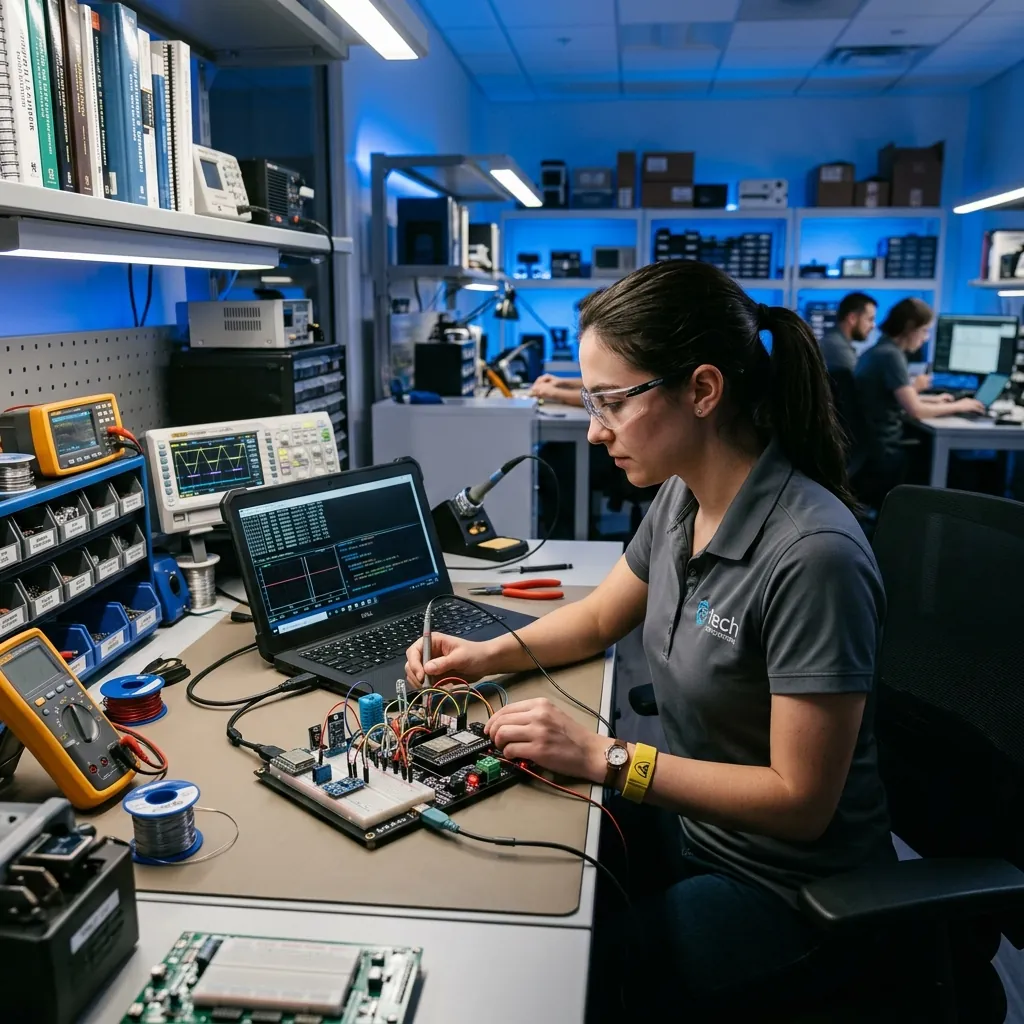
Bench conditions are generous. We validate against the conditions your device will actually meet - dropped connections, brownouts, temperature swings and years of uptime.
Proof of work
See the products behind the engineering
Connected devices, operational platforms and the software that ties hardware to the business systems around it. Browse the full portfolio.
Check our workWeb & mobile
Customer-facing products built to convert
Operations
Internal platforms replacing spreadsheets
AI systems
Automation wired into real workflows
Embedded
Firmware and connected devices in the field
Why WDF
One team from the sensor to the dashboard
Most embedded problems live at a boundary - firmware to cloud, device to app, prototype to production. Owning both sides of those boundaries is what stops them becoming somebody else's problem.
We work at both ends of the stack
The same team writes the firmware and the cloud service or dashboard it talks to - so the interface between them is designed, not negotiated between vendors.
Built for manufacturing, not for the demo
Provisioning, calibration, diagnostics and update paths are designed in from the start, because retrofitting them after tooling is far more expensive.
Honest about constraints
If your power budget or MCU choice will not support the requirement, we will say so during scoping rather than discovering it three months in.
Full ownership and documentation
Source, toolchain configuration, schematics of the software architecture and test evidence are yours. Your team can take it over at any point.
Long-term thinking
Devices live in the field for years. We write firmware that can still be built, patched and understood long after the original project ends.
Constraints scoped first
Power, timing and cost budgets agreed before development.
Full IP ownership
Source, toolchain and documentation handed over.
Tested on real hardware
Soak, stress and power profiling on the actual target.
Reply within 24 hours
A real engineer, usually much sooner.
Warehouse robotics
Robots are the easy part. The software is not.
Most warehouse automation projects stall on integration, not on hardware. If you are weighing AMR vendors, this is the part to get right first.
On the firmware side, our update architecture follows the IETF SUIT reference model - RFC 9019 - so a signed over-the-air update is verifiable end to end rather than trusted because it arrived. On the fleet side, VDA 5050 keeps an AMR fleet multi-vendor instead of locking you to whoever supplied the first ten robots.
Vendor fleet software tends to have fixed routing logic, weak WMS integration and a scalability ceiling you find at fifty robots rather than five. We build the control layer that sits above the hardware - so the fleet answers to your operation instead of the other way round.
Common questions
Embedded engineering questions, answered
What hardware and product teams ask us most before starting a firmware project.
We are a software and firmware team, so we work with your hardware - your PCB, your chosen MCU, your sensors. We collaborate closely with hardware engineers during bring-up and will flag design decisions that will cause software or reliability problems, but we do not take on schematic and PCB layout ourselves.
Something not covered here?
Ready to engineer the future?
Tell us about the device, the constraints and where it is currently stuck. You will get an honest engineering read before any commitment.
Prefer to talk directly?
Fixed-cost proposal. Full source ownership. Tested on your hardware.
