Custom Operations Software
Custom Operations Software
Stop bending your business around software that almost fits. We build the internal systems your operation actually runs on - owned outright, integrated with what you already have, and designed around how your team really works.
Client success
Trusted by innovators
Don't just take our word for it. Here's what our partners say about our straightforward approach and dedication to their success.
No miscommunication, no surprises - clear outlines from day one and genuine support throughout. Exactly what we needed.
Private project
Bookkeeping & Order Management Software
Stunning website for our vacation home plus marketing materials that actually convert - social posts, physical fliers, the full package.
Vladimirovs House
Vacation Home Website

They took us online for the first time and our client portfolio grew immediately. Even threw in social media content as a bonus.
D.M. Security
Security Services Company Website

After months of searching for the right team, WDF nailed our vision on the first attempt. Couldn't be more satisfied with the result.
LUMIÈRE Joaillerie
3D Jewellery E-Commerce shop, Full Stack
No miscommunication, no surprises - clear outlines from day one and genuine support throughout. Exactly what we needed.
Private project
Bookkeeping & Order Management Software
Stunning website for our vacation home plus marketing materials that actually convert - social posts, physical fliers, the full package.
Vladimirovs House
Vacation Home Website
They took us online for the first time and our client portfolio grew immediately. Even threw in social media content as a bonus.
D.M. Security
Security Services Company Website
After months of searching for the right team, WDF nailed our vision on the first attempt. Couldn't be more satisfied with the result.
LUMIÈRE Joaillerie
3D Jewellery E-Commerce shop, Full Stack
No miscommunication, no surprises - clear outlines from day one and genuine support throughout. Exactly what we needed.
Private project
Bookkeeping & Order Management Software
Stunning website for our vacation home plus marketing materials that actually convert - social posts, physical fliers, the full package.
Vladimirovs House
Vacation Home Website
They took us online for the first time and our client portfolio grew immediately. Even threw in social media content as a bonus.
D.M. Security
Security Services Company Website
After months of searching for the right team, WDF nailed our vision on the first attempt. Couldn't be more satisfied with the result.
LUMIÈRE Joaillerie
3D Jewellery E-Commerce shop, Full Stack
No miscommunication, no surprises - clear outlines from day one and genuine support throughout. Exactly what we needed.
Private project
Bookkeeping & Order Management Software
Stunning website for our vacation home plus marketing materials that actually convert - social posts, physical fliers, the full package.
Vladimirovs House
Vacation Home Website
They took us online for the first time and our client portfolio grew immediately. Even threw in social media content as a bonus.
D.M. Security
Security Services Company Website
After months of searching for the right team, WDF nailed our vision on the first attempt. Couldn't be more satisfied with the result.
LUMIÈRE Joaillerie
3D Jewellery E-Commerce shop, Full Stack
The problem
Your operation has outgrown its tools
Almost every growing business hits the same wall. The symptoms are familiar long before anyone calls it a software problem.
The business runs on spreadsheets
Critical numbers live in files with names like final_v3_USE_THIS.xlsx, on one person’s laptop. Everyone knows it is fragile. Nobody has time to fix it.
Your systems do not talk to each other
Sales, finance and operations each have a tool, and staff are the integration layer - copying the same record into three places and reconciling the differences later.
You pay per seat for software that half fits
Licence costs scale with headcount, the roadmap belongs to somebody else, and the features you actually need are always in the next tier or the next quarter.
Nobody can see the whole picture
Getting a straight answer about stock, margin or throughput means asking three departments and waiting a day. By the time the report lands, the decision has moved on.
Key solutions
The systems that carry your operation
Built to your workflow, integrated with your stack, and handed over with the keys.
Legacy System Modernization
We modernise the system your business already depends on - faster, cleaner and far more secure - without a big-bang cutover that puts operations at risk. In most cases the core system stays exactly where it is.
- Phased, zero-downtime migration
- No core-system replacement required
- Data preserved and reconciled
Supply Chain & Inventory
End-to-end visibility of stock, procurement and delivery, with automated reordering and live tracking that cuts both waste and lead times.
- Inventory optimisation
- Automated procurement
- Real-time logistics tracking
Business Intelligence Dashboards
One place where the real numbers live, pulled from every department automatically. Decisions get made on today’s data instead of last month’s export.
- Cross-department consolidation
- Live operational metrics
- Scheduled reporting
Workflow Automation
Approvals, handoffs, notifications and status changes handled by the system. The manual chase disappears and nothing gets stuck in someone’s inbox.
- Approval chains
- Exception handling
- Full audit trail
System Integration & Middleware
Custom APIs and middleware that make finance, sales and operations tools agree with each other, creating one version of the truth instead of four.
- ERP / CRM connectors
- Two-way data sync
- Single source of truth
Internal Tools & Portals
Purpose-built interfaces for the people doing the work - staff consoles, client portals, field apps - designed around the job rather than a generic CRUD screen.
- Role-based access
- Mobile and field-ready
- Built around real workflows
UAE e-invoicing (PINT AE) integration
E-invoicing becomes mandatory in the UAE from 2027. We connect ERPs, accounting platforms and legacy systems to your Accredited Service Provider, and validate PINT AE invoice data before it is submitted.
Not sure whether to rebuild, integrate or replace? Start with the review.
Walk us through how the work flows today. We will show you where the time is going, what could be automated, and what genuinely needs building - before any commitment.
The business case
What owning your systems actually changes
The return shows up in hours recovered, licences no longer paid, and decisions made on data that is current.
Hours reclaimed every week
The manual reconciliation, rekeying and chasing that fills your team’s day simply stops being part of the process.
Decisions on current data
Live operational visibility instead of a monthly export - so problems get caught while they are still small.
No more per-seat licence creep
You own the software. Adding the tenth user or the hundredth costs you nothing extra.
Growth without proportional headcount
Systems built for your workflow absorb more volume without needing more people to hold it together.
Security and control you can prove
Role-based permissions, audit logs and data you actually hold - which matters when a client or regulator asks.
Software your team will use
Built around how the work actually happens, so adoption does not need to be enforced.
Selected Portfolio
A look inside custom platforms we've engineered for clients across finance, healthcare, and global logistics.
Financial Operations Platform
A custom-built accounting system designed to replace fragmented spreadsheets and legacy bookkeeping tools. Features automated reconciliation, real-time ledger synchronization, and intelligent document processing - giving finance teams a single source of truth across all transactions.
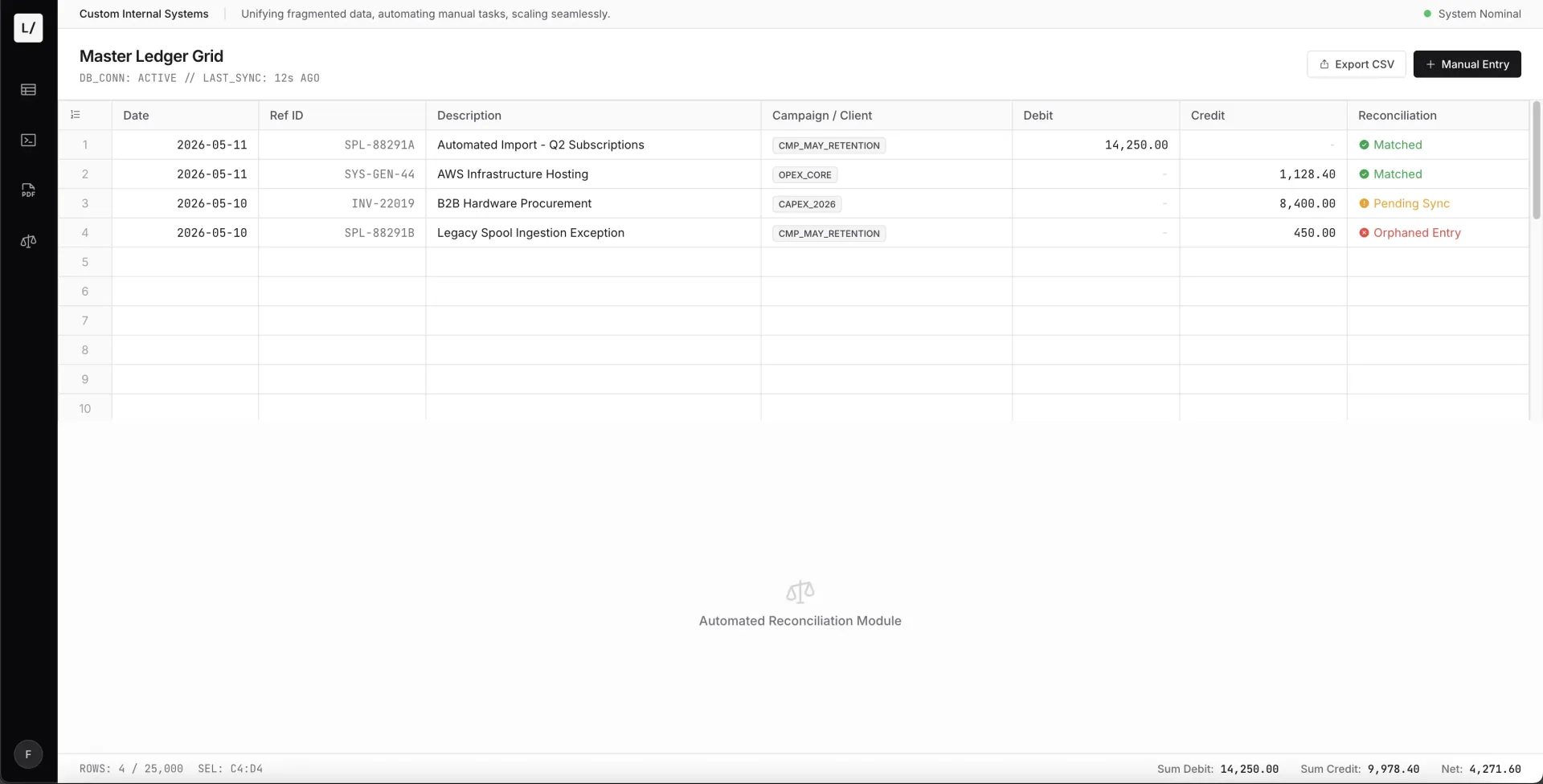
Master Ledger Grid:Real-time ledger with automated reconciliation status tracking, debit/credit summaries, and CSV export. Connected to a live database with 12-second sync cycles.
This is a slice of the work. The full portfolio has the rest.
View all projectsHow it works
Delivered in phases, not in one leap
Operations software fails when it lands all at once. We sequence it so value arrives early and the risk stays small.
Operational discovery
We sit with the people doing the work and map the process as it really runs - including the workarounds. That is usually where the biggest wins are hiding.
Architecture & roadmap
A system design, integration plan and phased roadmap, sequenced so the highest-value module ships first rather than everything landing at the end.
Iterative build
Two-week sprints with a working environment your team can log into. Feedback changes the next sprint instead of becoming a change request after launch.
Migration & rollout
Data migration with reconciliation, parallel running where the risk warrants it, and training so the switch does not stall operations.
Support & evolution
Post-launch support, monitoring and an ongoing backlog. The system keeps developing as the business does - and you own every bit of it.
Working in healthcare?
Clinical operations carry their own compliance and interoperability requirements. See our medical software development service.
Proof of work
The full portfolio - beyond operations
Web and mobile products, AI automation and embedded systems built for clients across finance, healthcare and logistics. Browse the work and the problems behind it.
Check our workWeb & mobile
Customer-facing products built to convert
Operations
Internal platforms replacing spreadsheets
AI systems
Automation wired into real workflows
Embedded
Firmware and connected devices in the field
Why WDF
Operational independence, not another subscription
The point of custom software is that the roadmap belongs to you. Everything we build is designed so you could walk away from us tomorrow and lose nothing.
Based in the UAE? We work from Dubai, in your timezone and in Arabic or English - see our software development company in Dubai.
Full ownership, no licence treadmill
You own the source code, the data and the roadmap. No per-user fees, no vendor deciding what you are allowed to build next.
Built for the workflow you actually have
We do not ask your business to reshape itself around a product. The system is designed around how your team already works.
Scales without hitting a ceiling
Architecture chosen so growth in data and users is a capacity question, not a re-platforming project.
We handle the integration mess
Legacy databases, ERPs and third-party APIs with poor documentation are routine work for us, not a reason to scope you out.
Delivered in phases you can see
Value ships early and often. You are never waiting nine months to find out whether it worked.
Discovery before code
The process is mapped and agreed before anything is built.
Full IP ownership
Source, data and documentation belong to you.
Migration without downtime
Phased rollout designed to keep operations running.
Reply within 24 hours
A real engineer, usually much sooner.
Legacy modernization
Modernize without replacing your core systems
The expensive way to modernise is to rip out the system of record. The cheap way is to leave it running and rebuild everything around it.
Wrap, don’t replace
The old system keeps doing what it reliably does. A modern API layer sits in front of it, and every new capability is built against that layer instead of against thirty-year-old internals.
Migrate one capability at a time
Route a single function to the new system, run both in parallel until the numbers reconcile, then retire the old path. Repeat. Every step is independently reversible, which is what makes it safe.
No maintenance window required
Operations that run continuously - logistics, clinical, aerospace, manufacturing - never get a weekend to cut over. Phased migration is not a preference in those environments; it is the only option.
We have done this for aerospace and avionics operators, clinical systems and freight platforms - the environments where downtime is not an inconvenience but a stoppage.
Common questions
Custom software questions, answered
What operations and finance leaders ask us most before committing to a build.
Not on day one - it is a project cost rather than a subscription. It usually wins over a three to five year horizon, because per-seat licences scale with your headcount while owned software does not, and because you stop paying people to work around features the product does not have. We model that comparison honestly during discovery, and if the maths favours an off-the-shelf tool we will tell you.
Something not covered here?
Ready to supercharge your operations?
Tell us where the process breaks down today. You will get an honest read on what to build, what to integrate and what to leave alone.
Prefer to talk directly?
Fixed-cost proposal. Full ownership. Phased delivery.
