The Safe Path to Tomorrow: Orchestrating an In-Flight Software Modernization
How to modernize legacy systems without grounding operations - strategies for zero-downtime transformation that keep your business running.
By Felipe Bongiolo, WDF
Your legacy system works. It processes transactions, manages inventory, serves customers - it does what it was built to do. The problem isn't that it's broken today. The problem is that it's slowly becoming incompatible with tomorrow.
And here's the dilemma every CTO and VP of Engineering faces: you can't stop the plane to rebuild the engine mid-flight. Your business depends on these systems running 24/7. Customers don't care about your technical debt. They care that the service works.
This is the art of in-flight software modernization - upgrading, refactoring, and transforming legacy systems while they continue to serve production workloads. It's one of the hardest challenges in enterprise software engineering, and getting it wrong can be catastrophic.
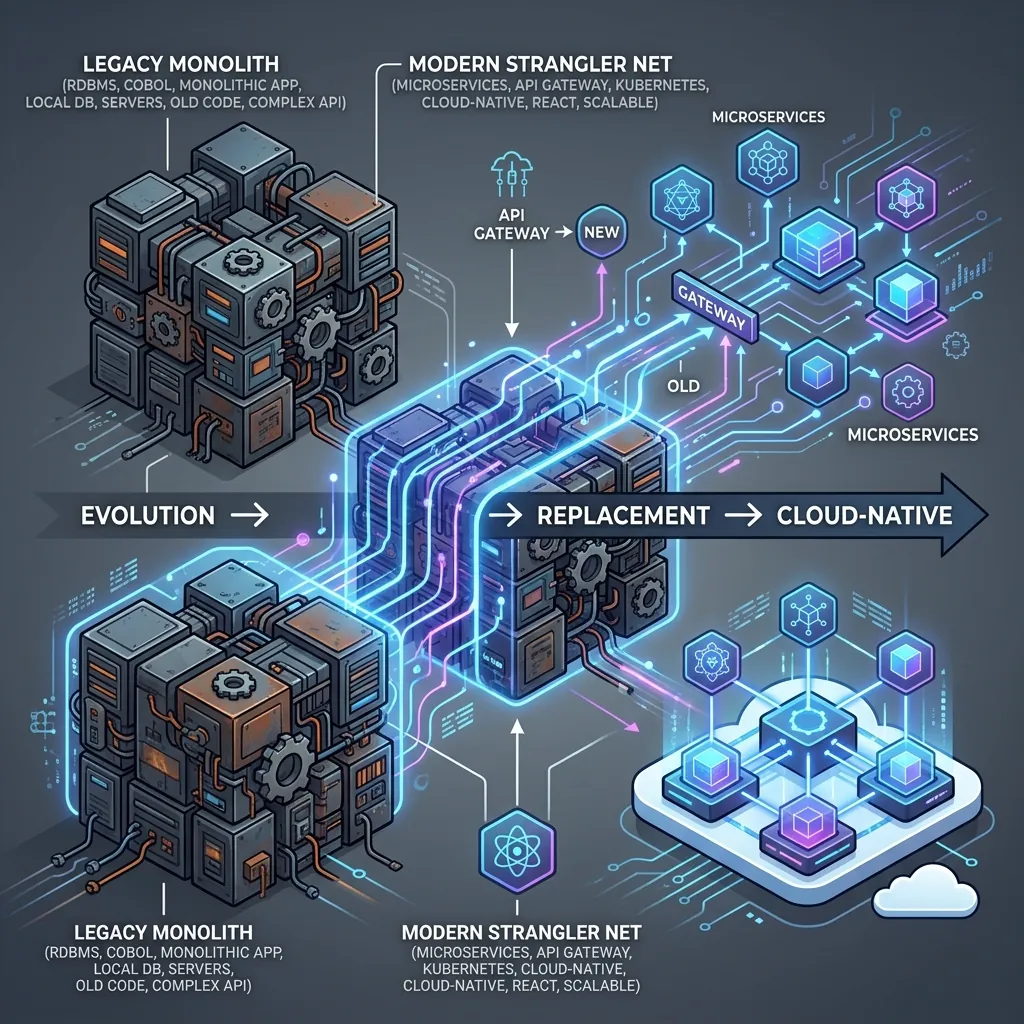
The Strangler Fig Pattern: Incrementally wrapping and replacing a legacy monolith with a modern cloud-native network
Why Modernization Can't Wait (Even When It Feels Like It Can)
Legacy systems accumulate what engineers call "technical debt" - shortcuts, outdated patterns, and dependency rot that compound over time. The costs are real:
- Talent drain: Skilled developers don't want to work on COBOL, Delphi, or unmaintained Java 6 codebases. Recruiting and retention suffer.
- Integration paralysis: Modern APIs, cloud services, and AI tools can't interface with systems designed for a different era.
- Security exposure: Legacy systems often run on unsupported frameworks with known vulnerabilities that can't be patched.
- Scaling ceilings: Monolithic architectures hit performance walls that no amount of hardware can fix.
- Compliance risk: Regulations evolve. Systems that can't adapt create audit failures and legal liability.
"The best time to modernize was five years ago. The second best time is now - but carefully."
- Enterprise architecture wisdom
The Big-Bang Rewrite: A Cautionary Tale
The most tempting approach is also the most dangerous: shut everything down, rewrite from scratch, and launch the new system on a magic Monday morning. History is littered with failures:
- Netscape 6.0 - rewrote from scratch, took 3 years, and nearly killed the company
- Healthcare.gov launch - a $1.7 billion system that crashed on day one
- Countless ERP migrations - where "go-live" becomes "go-crisis"
The big-bang rewrite fails because it underestimates the implicit knowledge embedded in legacy systems - years of edge cases, business rules, and integrations that nobody documented but everyone depends on.
The Strangler Fig Pattern: Modernize Without the Massacre
Named after the tropical fig that gradually envelops and replaces its host tree, the Strangler Fig pattern is the gold standard for in-flight modernization. The concept is simple:
- Identify a bounded context - a specific module, feature, or workflow within the legacy system.
- Build the modern replacement - using current architecture, languages, and cloud infrastructure.
- Route traffic incrementally - using a facade layer that directs requests to either the old or new system.
- Validate and verify - run both systems in parallel, compare outputs, catch discrepancies.
- Retire the legacy piece - once the modern component is proven, decommission the old one.
- Repeat - move to the next bounded context until the legacy system is fully replaced.
The beauty of this approach is that at every step, the system remains operational. There's no single point of failure. If the new component has issues, you roll back to the legacy version. The business never notices.
Five Strategies for Safe In-Flight Modernization
1. Feature Flags and Progressive Rollouts
Deploy new functionality behind feature flags that can be toggled per user, per region, or per percentage of traffic. This transforms a risky "big release" into a series of safe, measurable experiments:
- Roll out to 1% of users, monitor, then expand to 10%, 50%, 100%
- Instant rollback without deployment - just flip the flag
- A/B testing between legacy and modern implementations
- Reduced blast radius if something goes wrong
2. Event-Driven Decoupling
Legacy systems are often tightly coupled - changing one component breaks three others. Event-driven architecture (using message queues like Kafka, RabbitMQ, or cloud-native services) creates a buffer:
- New and legacy components communicate through events, not direct calls
- You can replace consumers or producers independently
- The event log provides an audit trail and replay capability
- Systems can evolve at their own pace without synchronization nightmares
3. Database Decomposition
The legacy monolith's database is often the hardest part to modernize. A shared database creates invisible coupling. The strategy:
- Change Data Capture (CDC): Use tools like Debezium to stream changes from the legacy database to new services
- Dual writes during transition: Write to both old and new databases, verify consistency
- Read replicas: New services read from their own data stores while the legacy system remains the write master
- Gradual cutover: Shift write responsibility to new services one domain at a time
4. Automated Regression Testing
Modernization without comprehensive testing is just hoping for the best. Build a safety net:
- Record and replay: Capture real production traffic and replay it against the new system
- Contract testing: Verify that new services honor the same API contracts as legacy ones
- Shadow testing: Run new code in production but don't serve its results - compare them silently to the legacy output
- Automated comparison: Tools that diff legacy vs. modern responses at scale
5. Observability-First Migration
You can't modernize what you can't observe. Before changing a single line of code, invest in:
- Distributed tracing: Follow requests across legacy and modern components
- Real-time dashboards: Error rates, latency, throughput - broken down by legacy vs. modern
- Alerting on divergence: Get notified immediately when modern and legacy outputs disagree
- Business KPI monitoring: Track conversion rates, revenue, and user satisfaction - not just technical metrics
The Human Side of Modernization
Technology is only half the challenge. In-flight modernization requires organizational alignment:
- Executive sponsorship: Modernization is a multi-quarter investment. Without leadership buy-in, it dies at the first budget review.
- Cross-functional teams: Engineers who understand the legacy system must work alongside those building the new one. Knowledge transfer is non-negotiable.
- Clear communication: Stakeholders need to understand that modernization is a journey, not a project. Set realistic timelines and celebrate incremental wins.
- Cultural shift: Move from "don't touch it, it works" to "we continuously improve." This requires psychological safety and a blameless culture.
When to Consider a Partner
Not every organization has the internal expertise to execute an in-flight modernization. Consider bringing in a specialized partner when:
- Your team lacks experience with the target architecture (microservices, cloud-native, event-driven)
- The legacy system uses technologies that current team members don't understand
- You need to maintain velocity on product features while modernizing infrastructure
- Regulatory requirements demand documented, auditable migration processes
Final Thought
Software modernization isn't about chasing the latest framework or rewriting code for the sake of modernity. It's about ensuring your technology can support your business strategy - today, next year, and ten years from now. The organizations that thrive are the ones that treat modernization as a continuous, disciplined practice, not a one-time project.
The plane doesn't need to land for the engine to be upgraded. But it takes skilled engineers, the right instruments, and unwavering focus to do it safely.
Need help modernizing your legacy systems without disrupting operations? We build legacy system modernization without replacing core systems - incremental migrations that leave the system of record running while the layer around it is rebuilt. Let's discuss your modernization roadmap.
Based in Dubai or elsewhere in the UAE? See our legacy system modernization in Dubai, where the 2027 e-invoicing mandate is pushing many older finance systems to change.
Related Articles
How WDF does this in practice
This is work we do for clients every week. Here is what that looks like as a service:
