
PINT AE Format in the UAE: E-Invoicing Requirements, Deadlines and How to Comply
What the UAE’s mandatory e-invoicing system requires, when your business has to be live, and how to get your ERP and accounting systems ready — for businesses in Dubai and across the Emirates.
By Felipe Bongiolo, WDF
From 2027, most businesses in the UAE will no longer be able to email a PDF and call it a tax invoice. Under the country’s mandatory e-invoicing system, every B2B and B2G invoice has to be issued as structured data in a single format — PINT AE — and exchanged through an Accredited Service Provider that reports it to the Federal Tax Authority.
This guide explains what the PINT AE format is, which deadline applies to your business, how the five-corner model works, what the penalties are, and what your ERP or accounting system needs to do before go-live. It is written for finance and operations teams in Dubai and across the Emirates who need a plan, not just a summary of the law.
UAE e-invoicing at a glance
- Format: PINT AE, the UAE version of the Peppol International invoice model (UBL 2.1 XML).
- Scope: B2B and B2G invoices and credit notes. B2C is excluded for now.
- First deadline: businesses with revenue of AED 50 million or more go live on 1 January 2027, and must appoint an ASP by 30 October 2026.
- Everyone else: 1 July 2027 for businesses below AED 50 million, and 1 October 2027 for government entities.
- Penalties: AED 5,000 for each month you are late, and AED 100 for each invoice not issued electronically on time.
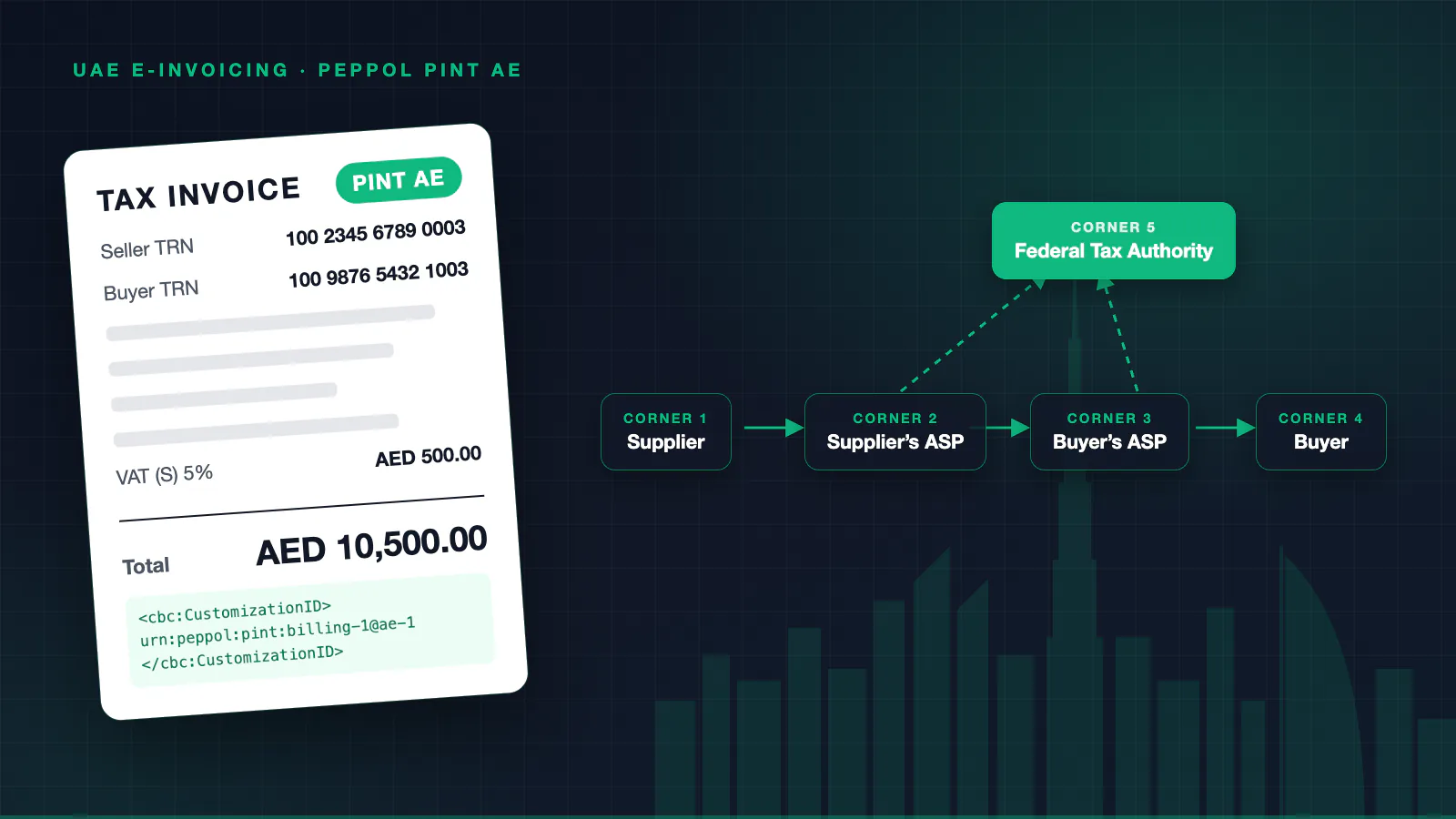
The UAE five-corner model: invoices travel between Accredited Service Providers, and tax data goes to the FTA
What is the PINT AE format?
PINT AE is the United Arab Emirates’ specialisation of Peppol PINT, the Peppol International invoice model maintained by OpenPeppol. It defines exactly which data an e-invoice carries and how that data is structured, so any Accredited Service Provider can validate it and any buyer’s system can read it without someone re-keying it.
In practice, a PINT AE invoice is an XML document in the UBL 2.1 syntax. It is not a PDF, a scan or an email attachment. Those can still travel alongside it as a human-readable copy, but the structured data is the invoice.
| Element | PINT AE value |
|---|---|
| Specification identifier (CustomizationID) | urn:peppol:pint:billing-1@ae-1 |
| Business process (ProfileID) | urn:peppol:bis:billing |
| Syntax | UBL 2.1 Invoice and Credit Note |
| Document type codes | 380 tax invoice · 381 tax credit note · 389 self-billed invoice · 261 self-billed credit note · 480 and 81 for out-of-scope invoices and credit notes |
| Participant identifier scheme | 0235, the UAE Tax Registration Number (TRN) |
| Tax currency | AED: tax amounts are stated in dirhams, even when the invoice is issued in another currency |
OpenPeppol publishes the specification in numbered versions — 1.0.4 is the latest listed at the time of writing — so confirm with your ASP which version it validates against before you build anything.
Is e-invoicing mandatory in the UAE?
Yes. Federal Decree-Law No. 16 of 2024 amended the VAT law to recognise electronic invoices and electronic credit notes, and two Ministry of Finance decisions issued in September 2025 set out how the system works: Ministerial Decision No. 243 of 2025 on its scope, and Ministerial Decision No. 244 of 2025 on its phased implementation.
The system applies to business-to-business (B2B) and business-to-government (B2G) transactions. Business-to-consumer (B2C) invoices are excluded for now, as are a few narrow categories, including certain international airline services and VAT-exempt or zero-rated financial services. If one of those might apply to you, check the detail with your tax adviser: the exclusions are specific.
UAE e-invoicing deadlines: when your business must go live
Which deadline applies depends on revenue, meaning the gross income your business earned in its most recent accounting period.
| Who | Appoint an ASP by | Go live |
|---|---|---|
| Any business adopting voluntarily | — | From 1 July 2026 |
| Revenue of AED 50 million or more | 30 October 2026 (extended from 31 July 2026) | 1 January 2027 |
| Revenue below AED 50 million | 31 March 2027 | 1 July 2027 |
| Government entities | 31 March 2027 | 1 October 2027 |
The appointment deadline for the first wave was originally 31 July 2026. Ministerial Resolution No. 66 of 2026 moved it to 30 October 2026 after feedback from businesses, but the go-live date did not move: businesses above AED 50 million still have to be issuing e-invoices on 1 January 2027. The extra time is for choosing a provider, not for starting the project later.
Since 1 July 2026 any business can join the system voluntarily, and a pilot with selected businesses and service providers has been running since the same date.
How UAE e-invoicing works: the five-corner model
The Ministry of Finance calls its model Decentralised Continuous Transaction Control and Exchange (DCTCE). Instead of uploading invoices to a single government portal, businesses exchange them through accredited intermediaries on the Peppol network, and tax data is reported to the Federal Tax Authority as each invoice moves.
- Corner 1 — Supplier. Your system produces the invoice data.
- Corner 2 — Supplier’s ASP. Validates the data and converts it into PINT AE XML.
- Corner 3 — Buyer’s ASP. Receives the invoice over the Peppol network.
- Corner 4 — Buyer. Receives structured data it can post straight into accounts payable.
- Corner 5 — Federal Tax Authority. Receives a tax data document from the service providers.
Two consequences matter for planning. First, you need an ASP on the receiving side as well as the sending side, because your suppliers’ e-invoices will arrive through it. Second, a provider can only validate the data your system gives it: if a TRN, a tax category or a transaction code is wrong at the source, the invoice is rejected, not repaired.
What a PINT AE invoice must contain
The Ministry of Finance publishes the mandatory data fields for UAE electronic invoices, and the PINT AE specification defines how each one is expressed. These are the fields that most often need work inside an existing ERP:
- Tax Registration Numbers for both parties, held as clean customer and supplier master data rather than typed into free-text fields.
- The invoice transaction type code: eight yes-or-no flags marking whether a supply involves a free zone, a deemed supply, the profit margin scheme, a summary invoice, a continuous supply, disclosed agent billing, e-commerce or exports.
- A tax category on every line: standard rate (S), zero-rated (Z), exempt (E), outside the scope of VAT (O) or reverse charge (AE).
- Tax amounts in AED, calculated consistently with the line totals, even when the invoice itself is in another currency.
- The right document type: tax invoices, credit notes, self-billed documents and out-of-scope documents each have their own code.
None of this is exotic. But in most businesses at least one of these lives in a spreadsheet, a free-text description or one person’s head, and finding those gaps is the first real piece of work.
Choosing an Accredited Service Provider (ASP) in the UAE
Only providers accredited by the Ministry of Finance can connect you to the system. The Ministry publishes and updates the official list of accredited and pre-approved eInvoicing service providers. To be accredited, a provider must, among other requirements, be an active Peppol-certified service provider with at least two years’ experience operating an e-invoicing solution.
Questions worth asking before you sign:
- “How do you connect to our ERP or accounting system?” A ready-made connector, an API you integrate with, and a file upload you have to automate yourself are three very different projects.
- “What happens when an invoice is rejected?” Rejection reasons need to come back to the system that issued the invoice, not sit in a portal nobody checks.
- “Do you handle inbound e-invoices as well?” Receiving is half the obligation.
- “Which PINT AE version do you validate against, and how do you handle updates?” The specification is versioned, and your data has to keep passing.
- “How are e-invoices archived, and how do we get them back out?” You will need them for audits and VAT refunds.
Penalties for not complying with UAE e-invoicing
Administrative penalties are set by Cabinet Decision No. 106 of 2025:
| Violation | Penalty |
|---|---|
| Not appointing an Accredited Service Provider, or not implementing the system, by the deadline | AED 5,000 for each month of delay |
| Not issuing or transmitting an e-invoice on time | AED 100 per invoice, capped at AED 5,000 a month |
| Not issuing or transmitting an electronic credit note on time | AED 100 per credit note, capped at AED 5,000 a month |
| Not notifying the authority of a system failure on time (issuer or recipient) | AED 1,000 for each day of delay |
| Not telling your ASP about changes to your registered data on time | AED 1,000 for each day of delay |
The fines are real, but for most businesses the bigger cost of missing the deadline is operational: customers who cannot accept your invoices, and payments that wait while you fix the problem.
How to get ready: a six-step plan for UAE businesses
- Confirm your scope and your date. Work out which of your entities trade B2B or B2G, which revenue band each falls into, and so which deadline applies. Groups with several entities often find they have more than one.
- Run a data gap assessment. Compare what your ERP actually holds with the mandatory fields: TRN master data, transaction type flags, tax categories, AED tax amounts and credit note handling.
- Choose and appoint an ASP. Shortlist from the Ministry’s list, test each provider’s integration options against your own systems, and appoint one before your deadline — 30 October 2026 for the first wave.
- Build the integration. Map your invoice data to PINT AE, validate it before it leaves your system, and handle the statuses and rejections that come back.
- Test end to end. Put every invoice type you actually issue — credit notes, self-billing, exports, free zone supplies — through your provider’s test environment, not only a standard tax invoice.
- Go live and monitor. Watch rejection rates daily for the first few weeks, route exceptions to someone who can fix the source data, and confirm your archive is complete.
For a business with one modern ERP and a provider with a ready-made connector, this can take a matter of weeks. With several entities, a legacy accounting system or invoices generated by bespoke operational software, allow a few months — and start with step two, because it decides the size of everything after it.
Where custom software fits in UAE e-invoicing
An ASP handles validation, exchange and reporting. What it cannot do is make the data coming out of your systems complete and correct, and that is where most e-invoicing projects actually stall. The situations we see most often:
- Legacy or bespoke systems with no ASP connector, where invoices come out of in-house operational software or an older accounting package.
- Several entities or systems issuing invoices, each with its own master data and numbering.
- Validation before submission, so TRNs, tax categories and transaction codes are checked at the source instead of rejected after go-live.
- Rejection and exception handling that feeds back into the system that issued the invoice, with a dashboard your finance team can act on.
- Inbound e-invoices posted automatically into accounts payable instead of being printed and re-keyed.
Our custom operations software service builds exactly this layer: integrations between your ERP, accounting or operational systems and your chosen ASP, PINT AE data mapping and pre-submission validation, delivered as a phased, fixed-cost project with the source code handed over to you. We are not an Accredited Service Provider ourselves. We make sure the systems your provider connects to produce invoices that pass.
Not sure how big the gap is? and you will get an honest read on the work between today and your deadline.
UAE e-invoicing FAQ
What is PINT AE?
PINT AE is the UAE version of the Peppol International (PINT) invoice model: the structured XML format, based on UBL 2.1, that every e-invoice and electronic credit note in the UAE e-invoicing system must follow. It is published by OpenPeppol, and each invoice identifies itself with the specification ID urn:peppol:pint:billing-1@ae-1.
When does e-invoicing become mandatory in the UAE?
Businesses with revenue of AED 50 million or more must appoint an Accredited Service Provider by 30 October 2026 and go live on 1 January 2027. Businesses below AED 50 million must appoint one by 31 March 2027 and go live on 1 July 2027. Government entities go live on 1 October 2027. Any business has been able to adopt the system voluntarily since 1 July 2026.
Does UAE e-invoicing apply to B2C sales?
Not for now. The system covers business-to-business (B2B) and business-to-government (B2G) transactions. Business-to-consumer (B2C) invoices are excluded for the time being, as are a few narrow categories such as certain international airline services and VAT-exempt or zero-rated financial services.
Do I need an Accredited Service Provider (ASP)?
Yes. In the UAE five-corner model, suppliers and buyers exchange e-invoices through Accredited Service Providers, and the providers report the tax data to the Federal Tax Authority. Only providers accredited by the Ministry of Finance can do this, and the Ministry publishes the official list.
Is a PDF invoice still valid once e-invoicing is mandatory?
Not on its own. Once your business is in scope and live, tax invoices and credit notes have to be issued as structured PINT AE e-invoices and exchanged through an Accredited Service Provider. A PDF can still travel alongside as a human-readable copy, but the structured data is the invoice.
What are the penalties for not complying with UAE e-invoicing?
Cabinet Decision No. 106 of 2025 sets a fine of AED 5,000 for each month a business is late appointing an Accredited Service Provider or implementing the system, AED 100 for each e-invoice or electronic credit note not issued or transmitted on time (capped at AED 5,000 a month), and AED 1,000 for each day of delay in reporting a system failure or updating your provider about changes to your registered data.
Can we keep our current ERP or accounting system?
Usually, yes. Most businesses keep their ERP or accounting system and add an integration that turns its invoice data into complete PINT AE data and sends it to their Accredited Service Provider. The real work is normally in the data — Tax Registration Numbers, transaction type codes, tax categories and AED tax amounts — rather than in replacing the system.
Regulatory details in this article were checked against Ministry of Finance, Federal Tax Authority and OpenPeppol publications on 15 September 2026. Dates and rules can change, so confirm your own obligations with your tax adviser or Accredited Service Provider.
Official sources: UAE Ministry of Finance — eInvoicing programme · Federal Tax Authority — UAE e-invoicing · OpenPeppol — PINT AE specifications
How WDF does this in practice
This is work we do for clients every week. Here is what that looks like as a service:
