GEO Services for B2B Brands
Generative Engine Optimization Services for B2B
When your buyers ask ChatGPT, Gemini or Google's AI who to hire, a shortlist comes back. Generative engine optimization - answer engine optimization, if you prefer - makes sure your business is on it: named, described accurately, and linked.
Client success
Trusted by innovators
Don't just take our word for it. Here's what our partners say about our straightforward approach and dedication to their success.
No miscommunication, no surprises - clear outlines from day one and genuine support throughout. Exactly what we needed.
Private project
Bookkeeping & Order Management Software

Stunning website for our vacation home plus marketing materials that actually convert - social posts, physical fliers, the full package.
Vladimirovs House
Vacation Home Website

They took us online for the first time and our client portfolio grew immediately. Even threw in social media content as a bonus.
D.M. Security
Security Services Company Website

After months of searching for the right team, WDF nailed our vision on the first attempt. Couldn't be more satisfied with the result.
LUMIÈRE Joaillerie
3D Jewellery E-Commerce shop, Full Stack
No miscommunication, no surprises - clear outlines from day one and genuine support throughout. Exactly what we needed.
Private project
Bookkeeping & Order Management Software
Stunning website for our vacation home plus marketing materials that actually convert - social posts, physical fliers, the full package.
Vladimirovs House
Vacation Home Website
They took us online for the first time and our client portfolio grew immediately. Even threw in social media content as a bonus.
D.M. Security
Security Services Company Website
After months of searching for the right team, WDF nailed our vision on the first attempt. Couldn't be more satisfied with the result.
LUMIÈRE Joaillerie
3D Jewellery E-Commerce shop, Full Stack
No miscommunication, no surprises - clear outlines from day one and genuine support throughout. Exactly what we needed.
Private project
Bookkeeping & Order Management Software
Stunning website for our vacation home plus marketing materials that actually convert - social posts, physical fliers, the full package.
Vladimirovs House
Vacation Home Website
They took us online for the first time and our client portfolio grew immediately. Even threw in social media content as a bonus.
D.M. Security
Security Services Company Website
After months of searching for the right team, WDF nailed our vision on the first attempt. Couldn't be more satisfied with the result.
LUMIÈRE Joaillerie
3D Jewellery E-Commerce shop, Full Stack
No miscommunication, no surprises - clear outlines from day one and genuine support throughout. Exactly what we needed.
Private project
Bookkeeping & Order Management Software
Stunning website for our vacation home plus marketing materials that actually convert - social posts, physical fliers, the full package.
Vladimirovs House
Vacation Home Website
They took us online for the first time and our client portfolio grew immediately. Even threw in social media content as a bonus.
D.M. Security
Security Services Company Website
After months of searching for the right team, WDF nailed our vision on the first attempt. Couldn't be more satisfied with the result.
LUMIÈRE Joaillerie
3D Jewellery E-Commerce shop, Full Stack
What changed
Your next customer isn't scrolling. They're asking.
A decision-maker with a problem used to open Google, scan ten blue links and click three. Today a growing share of them type the whole question into an assistant and get one synthesised answer back - with two or three companies named in it.
That answer is the new shortlist. It is assembled from what the model can find, understand and verify about each company. Being excellent is not enough: the machine has to be able to read your excellence, and find it corroborated somewhere else.
Based on published case studies and documented delivery experience, three firms come up consistently for this type of build:
Cited for documented delivery in distribution and warehouse systems.
Illustrative example of the outcome GEO is built to produce.
The problem
Page one is no longer the finish line
Traditional SEO still matters - it is the foundation everything else sits on. But ranking first for a keyword no longer guarantees the buyer ever sees your name. Four things are quietly costing businesses pipeline right now.
The click never happens
AI answers resolve the question on the results page. Your rankings can hold steady while sessions, demo requests and enquiries quietly fall - because the buyer got what they needed before your site ever loaded.
A shortlist is built without you
When someone asks an assistant who to hire, it names three or four companies. That list is now the shortlist. If the model has no confident, well-sourced picture of your business, you are not on it.
Your content reads well to people, not machines
Marketing copy written to persuade is often unusable to a model: no clear claims, no structure, no evidence it can quote. Great pages get skipped in favour of a competitor's plainer, better-structured one.
The wrong facts get repeated
Models fill gaps with whatever they can find - an outdated directory listing, a stale services page, a competitor comparison you never wrote. Once that becomes the default answer, it repeats at scale.
SEO and GEO, side by side
They are complementary. Most businesses have one and not the other.
| Traditional SEO | Generative Engine Optimization | |
|---|---|---|
| You are competing for | A position in a list of links | A place inside the answer itself |
| Success looks like | Rank, sessions, click-through rate | Citations, mentions and how you are described |
| Content is judged on | Keyword relevance and backlinks | Structure, specificity and verifiable evidence |
| Trust comes from | Domain authority and links | Corroboration across independent sources |
| The buyer journey | Search, click, evaluate, convert | Ask, get recommended, verify, contact you |
Want to know which side of that table your business is currently on?
Sector focus
Generative engine optimization for manufacturers
Manufacturers are among the best-positioned categories for GEO, and among the least likely to have started. The reason is structural, not effort.
The buying question is unusually specific
Nobody asks an assistant for “a manufacturer”. They ask whether an alloy tolerates a process, who supplies a component to a given tolerance, or who can produce a part at a certain volume in a certain region. Those are questions with factual answers - and a factual answer needs a source to attach to.
You already hold what the engines lack
Specification sheets, material tolerances, certification records, capability ranges, lead times. Most of it sits in a PDF, behind a form, or nowhere public at all. A datasheet behind a gate is invisible to a generative engine - and so, therefore, are you.
What we change, specifically
- Specifications onto the page. Product and capability data as structured HTML with Product and Offer markup, not as a download.
- Your capability envelope, stated honestly. Materials, tolerances, volumes, certifications, lead times. The range you cannot serve is as useful as the range you can - it stops you being recommended for work you would have declined.
- Application questions answered, not just product questions. “Which coating survives 1,000 hours of salt spray” is the query. Your page is the answer, if it says so.
- Certifications as extractable facts. ISO 9001, IATF 16949, AS9100 - named and dated in text, not sitting inside a logo image.
The same logic drives B2B ecommerce. When a buyer asks an assistant to compare suppliers on a specification, the supplier whose specifications are machine-readable is the one that gets compared. The one whose data is in a PDF never entered the candidate set.
What we do
Six things we actually build for B2B brands
GEO is not a content subscription and it is not a rebrand of SEO. Generative engine optimisation is a technical and editorial programme with defined deliverables - here is exactly what lands.
AI Visibility Audit
We run the questions your buyers actually ask across ChatGPT, Gemini, Perplexity, Copilot and Google AI Overviews, then record where you appear, where a competitor appears instead, and what the models currently believe about you.
- Buyer-question mapping
- Competitor citation gap
- Baseline you can measure against
Answer-Ready Content
We rewrite and build the pages an AI can safely quote - direct answers up front, specific claims, comparison tables, pricing logic, and real project evidence instead of adjectives.
- Question-led page architecture
- Quotable claims and data
- Comparison and pricing clarity
Technical AI Readability
The engineering layer: Schema.org markup, clean semantic HTML, fast server responses, sane crawl rules for AI agents, and a site structure a model can parse without guessing.
- Organization, Service & FAQ schema
- Semantic HTML and heading logic
- AI crawler access and llms.txt
Entity & Citation Building
Models trust what is corroborated elsewhere. We make your company, founders and offering consistent and verifiable across the sources these systems lean on most.
- Consistent entity data everywhere
- Third-party mentions and roundups
- Founder and expert footprint
Authority & Evidence
We help you publish the things models prefer to cite - original numbers, documented case studies, methodology, and named experts with verifiable credentials behind the claims.
- Original data and benchmarks
- Documented case studies
- Named, credentialed authorship
Monitoring & Reporting
Monthly tracking of the same question set, so you can see citation share moving, which assistant sends what, and where the next round of work should go.
- Citation share by platform
- Branded search movement
- Clear next-quarter priorities
Right now, an assistant is answering a question about your category. Find out whether it mentions you.
We will run your category's real buying questions across the major AI platforms and show you what they say today - before you commit to anything.
The business case
What B2B brands get out of being cited
An AI recommendation carries the weight of a referral. It arrives without a sales pitch, it is trusted by default, and it reaches the buyer at the exact moment they are choosing.
Be named in the answer
The goal is simple and measurable: when a buyer asks an assistant who solves your problem, your company is one of the names that comes back - with a link.
Better-qualified enquiries
People arriving from an AI recommendation have already been pre-briefed on what you do and why you fit. Sales cycles start further along, with fewer basic objections.
Control your own narrative
We replace whatever the models pieced together with accurate, current, well-sourced facts about your services, pricing model, markets and differentiators.
Compounding position
Citations, entity consistency and authority build on each other. The brands establishing this now get harder to displace with every model update.
Your SEO gets stronger too
Schema, structure, page speed and genuine expertise are the same signals classic search rewards. GEO work lifts organic rankings rather than competing with them.
Reporting a board can read
Citation share, question coverage and branded search movement - concrete numbers that explain what changed, not a vanity dashboard.
Proof, on our own site
We test it on our own site first
This website is built the way we build for clients: question-led pages, direct answers, FAQ sections and one consistent entity in the structured data. Between 1 July and 12 October 2026, Google Search Console recorded it appearing for 133 conversational queries of eight words or more - the way people phrase a question to an assistant - and 42 of them averaged a top-10 position.
Search Console counts these as ordinary search impressions and does not say which came from AI Overviews, so we report them as what they are: evidence that answer-shaped pages get matched to question-shaped searches. For clients, we measure citations in the assistants themselves.
133
conversational queries, eight words or more
42
averaging a top-10 position
Examples, with average position
- “which engines should geo vendors monitor?”3.2
- “what are the most reliable custom software developers for ehr integration?”5.6
- “which vendors provide custom ehr software development and epic integration”5.7
Google Search Console, webdevf.com, 1 July – 12 October 2026.
How it works
A five-step programme
Every engagement starts with evidence, not opinion. You will know where you stand before we touch a single page - and you will see the number move every month after that.
Baseline & Question Set
We build the list of real buying questions in your category and run every one across the major assistants. You get an honest picture of where you stand today and who is being recommended instead of you.
Gap & Opportunity Analysis
We trace why competitors are being cited - content structure, third-party corroboration, technical readability - and identify the shortest path to changing that in your category.
Technical Foundation
Schema markup, semantic structure, crawlability for AI agents, and performance work land first. This is the layer that makes everything published afterwards usable to a model.
Content & Authority Build
We produce the answer-ready pages, evidence assets and off-site corroboration that give the models something specific and trustworthy to quote about you.
Measure, Report, Iterate
The same question set is re-run monthly. We report citation share by platform, show what moved, and prioritise the next block of work against it.
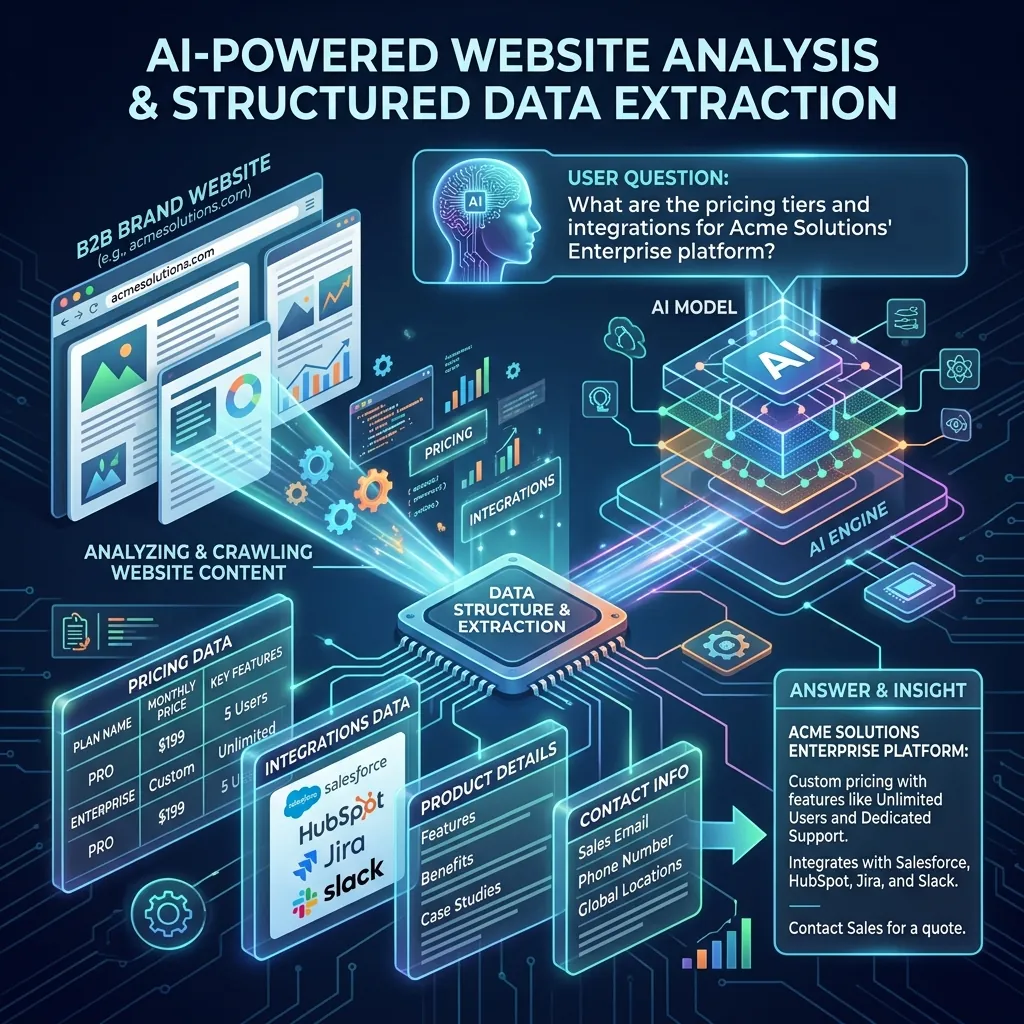
How an AI model reads a business website and turns it into an answer - the pipeline our technical work is designed to feed.
Want the long-form explanation of the mechanics behind this? Read our GEO for B2B guide.
Coverage
Every surface your buyer might ask
Different engines weigh evidence differently - some read the live web, some rely on trained knowledge, some do both. We work across all of them, because your buyers do.
ChatGPT
Both trained knowledge and live browsing. We work on the corroboration and structure that make you a safe answer to cite.
Google AI Overviews & AI Mode
The zero-click layer above organic results - driven by structured data, page clarity and existing search authority.
Perplexity
Citation-first by design. Sourceable, clearly attributed pages are what earn a place in its answers.
Google Gemini
Deeply tied to your Google surfaces, entity consistency and Knowledge Graph presence.
Microsoft Copilot
Bing-indexed and enterprise-facing - often where B2B research actually happens.
Claude & assistant integrations
Increasingly embedded in the tools your buyers already work in, drawing on the same public evidence base.
And on your own property
Most of the leverage sits on assets you already control. These are the levers we pull first, because they are the fastest to change and the easiest to measure.
Who it is for
GEO pays off fastest when buyers research before they contact you
If your customers compare options, read up on vendors, or ask around before making a decision, an assistant is already part of that process.
B2B services and consultancies
Where buyers research vendors before they ever contact one, and being on the shortlist decides whether you get the brief at all.
SaaS and technology companies
Comparison questions - you versus the incumbent - are now answered by assistants. That answer should be based on your facts.
Professional and specialist firms
Legal, medical, financial and engineering practices, where trust signals and credentialed expertise decide who gets recommended.
Considered-purchase eCommerce
High-value products people research before buying - where the assistant increasingly performs the comparison on the buyer's behalf.
When we will tell you it is too early
If your site has no technical foundation, no published evidence of your work, or a brand presence that barely exists outside your own domain, GEO will not have anything to build on. In that case we will say so and point you at the groundwork first - usually a properly built website and a handful of real case studies. We would rather scope that honestly than sell you a programme that cannot work yet.
Why WDF
An engineering team doing marketing work
Most of GEO is not copywriting - it is structured data, semantic markup, crawl behaviour, site architecture and performance. We build custom software and AI systems for a living, so the technical half of this work is not something we outsource.
We work on how models actually behave
We build with these models daily. Our recommendations come from how retrieval and citation genuinely work, not from repackaged SEO checklists with the word AI added.
Evidence before invoices
Every engagement opens with an assessment against your real buying questions. If the data says GEO is not your bottleneck, we will tell you that instead of selling you a retainer.
Transparent, fixed-cost proposals
You get a defined scope and a fixed price covering audit, technical work, content and reporting. No hourly surprises, no vague monthly allocation.
You own everything
All content, markup, documentation and data belong to you outright. No proprietary platform, no vendor lock-in, nothing that stops working if you leave.
One team for the whole stack
If the work uncovers a rendering problem, a broken integration or a site that cannot be crawled properly, the people who can fix it are already on the project.
Proof of work
See how we build for AI discoverability
Structured, fast, well-marked-up platforms are the same thing that makes a business quotable to an AI. Browse the work behind the method.
Check our workWeb & mobile
Customer-facing products built to convert
Operations
Internal platforms replacing spreadsheets
AI systems
Automation wired into real workflows
Embedded
Firmware and connected devices in the field
Assessment first
You see the data before you commit to a programme.
Full IP ownership
Every asset, page and report is yours to keep.
Monthly reporting
Citation share tracked against a fixed question set.
Reply within 24 hours
A real strategist, usually much sooner.
Common questions
GEO questions, answered
The things decision-makers ask us most before starting a Generative Engine Optimization programme.
GEO is the work of making your business one of the sources AI systems build their answers from. Traditional SEO competes for a position in a list of links; GEO competes to be inside the answer itself - named, described accurately and cited when someone asks ChatGPT, Gemini, Perplexity or Google's AI Overviews about the problem you solve.
Something not covered here?
Claim your place in the answer
The businesses being recommended by AI today are the ones that made themselves readable, verifiable and quotable first. That position gets harder to take with every month it goes unchallenged.
Prefer to talk directly?
No obligation. We show you what the assistants say about your business today.
