
GEO for B2B: How Generative Engine Optimization Gets Your Brand Cited by AI
SEO got you to page one. GEO gets you into the answer - the one AI gives before the user ever clicks a link.
By Felipe Bongiolo, WDF
For two decades, the playbook was simple: rank on Google, win the click, close the deal. But in 2026, the click is disappearing. AI-powered search engines like Google's AI Overviews, ChatGPT, Perplexity, and Microsoft Copilot don't just list links - they synthesize answers. And if your B2B brand isn't part of that synthesis, you're invisible.
Welcome to the era of Generative Engine Optimization (GEO) - generative engine optimisation in British spelling, and also called answer engine optimization - the discipline of making your brand, expertise, and content visible to the AI systems that are rapidly replacing traditional search for business decision-makers. The term was formalised in Aggarwal et al., “GEO: Generative Engine Optimization”, which set out the first measured framework for influencing what generative engines cite. This guide covers what GEO for B2B involves in practice, including what changes for manufacturers, lenders and software companies.
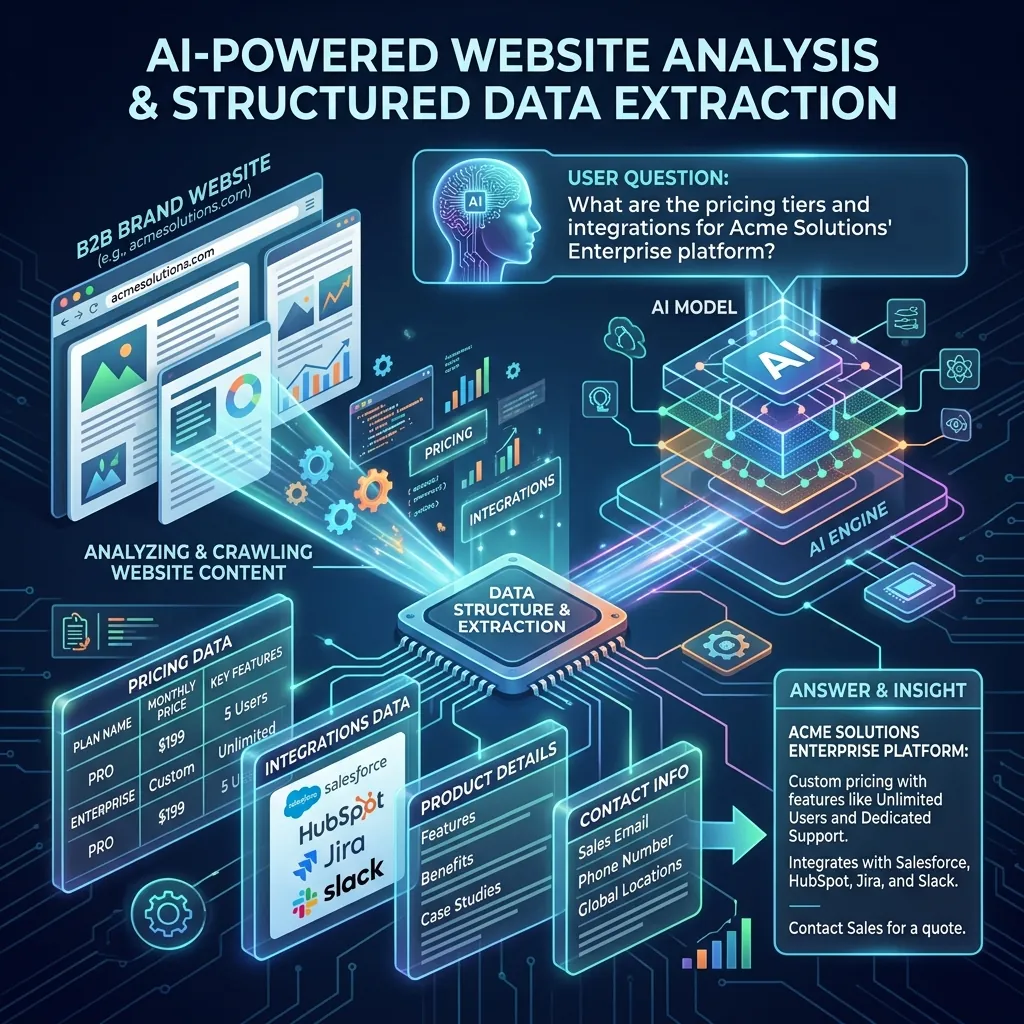
How AI models extract structured data from B2B websites to answer complex queries
What Is GEO, and Why Should B2B Leaders Care?
GEO is the practice of optimizing your digital presence so that large language models (LLMs) - the engines behind ChatGPT, Gemini, Claude, and AI-powered search - cite, reference, and recommend your brand when users ask relevant questions.
Think of it this way: traditional SEO optimizes for crawlers and ranking algorithms. GEO optimizes for AI comprehension and citation. The difference matters because:
- Zero-click is the new normal: AI Overviews, ChatGPT and Perplexity answer the question directly, so buyers often get what they need without visiting your site at all.
- B2B buyers already research with AI: in a Semrush survey of US B2B professionals (March–April 2026), 72% of those using AI at work said they use it during early research, and 92% said AI has shaped their vendor shortlist.
- Citation = credibility: when an AI cites your brand in its response, it carries implicit authority - like being quoted by an expert.
- Early movers compound: content and entity signals that AI systems already trust keep being reused in their answers, so the gap between brands that invest now and brands that wait widens over time.
How GEO Differs from Traditional SEO
SEO and GEO share DNA, but the optimization targets are fundamentally different:
| Dimension | Traditional SEO | GEO |
|---|---|---|
| Optimizes for | Search engine crawlers | Large language models |
| Success metric | Ranking position & clicks | Citations & mentions in AI answers |
| Content style | Keyword-optimized | Authoritative, factual, well-structured |
| Trust signals | Backlinks, domain authority | E-E-A-T, citations, structured data |
| User journey | Click → visit → convert | AI answer → trust → direct search |
The 7 Pillars of B2B Generative Engine Optimization
1. Become the Authoritative Source
LLMs prioritize content from sources they "trust" - determined by how often your content is cited, linked to, and corroborated by other authoritative sources. For B2B brands, this means:
- Publish original research, case studies, and industry benchmarks
- Contribute thought leadership to established publications
- Build a knowledge graph around your core expertise
- Ensure your founders and executives have strong digital footprints
2. Structure Content for AI Comprehension
AI models parse content differently than humans. They excel at extracting structured, unambiguous information:
- Use clear headings, subheadings, and logical hierarchy
- Include FAQ sections with concise, definitive answers
- Present data in tables, lists, and comparison formats
- Add Schema.org markup (Article, FAQ, HowTo, Organization) - and give every page a single organisation
@idthe whole site references, so an engine resolves one entity rather than a different anonymous company per page
3. Optimize for Conversational Queries
B2B buyers asking AI don't type keywords - they ask full questions: "What's the best approach to modernizing a legacy ERP system?" or "Which companies specialize in healthcare software development?"
- Map your content to real conversational queries your buyers ask
- Create comprehensive, question-and-answer style content
- Address the "who, what, when, where, why, how" of your domain
4. Build a Citation-Worthy Digital Presence
For an AI to cite you, it needs to find your brand across multiple credible sources:
- Maintain consistent brand information across directories, social profiles, and industry databases
- Get mentioned in industry roundups, expert panels, and comparison articles
- Publish on platforms that LLMs heavily index: Wikipedia, industry wikis, government databases, academic papers
- Leverage PR to get featured in news outlets that AI models reference
5. Invest in E-E-A-T at Scale
Google's E-E-A-T framework (Experience, Expertise, Authoritativeness, Trustworthiness) is now the backbone of how both search algorithms and LLMs evaluate content quality:
- Experience: Showcase real project outcomes, not theoretical advice
- Expertise: Attribute content to named experts with verifiable credentials
- Authoritativeness: Earn citations from peers and industry bodies
- Trustworthiness: Transparent methodologies, clear sourcing, honest limitations
6. Monitor Your AI Visibility
You can't optimize what you can't measure. Emerging tools and techniques for tracking GEO performance include:
- Querying AI platforms with your target questions and tracking whether you're cited
- Watching Search Console for the queries you target - appearances in AI Overviews are counted inside the normal web search data rather than reported separately, and Google documents how content is selected for AI features in Search, under the same eligibility rules as normal indexing
- Using tools like Otterly.ai, Profound, or custom LLM monitoring scripts
- Tracking branded search volume increases as a proxy for AI-driven awareness
7. Don't Abandon SEO - Layer GEO on Top
GEO doesn't replace SEO. The two are complementary:
- Strong SEO foundations (technical health, content quality, backlinks) directly support GEO
- Pages that rank well organically are more likely to be sourced by AI models
- Schema markup benefits both crawlers and LLM parsing
- Content that satisfies user intent for SEO also satisfies AI answer synthesis
Would rather have a team run the seven pillars?
Our generative engine optimization services start with an audit of what AI assistants say about your category today, then build the structured data, content and citations - and report every month on how often the answers name you.
The Stakes for B2B
The B2B buyer journey is already changing, and the forecasts go further. Gartner predicts that by 2028, 90% of B2B buying will be AI agent intermediated, pushing over $15 trillion of B2B spend through AI agent exchanges. If your brand is not legible to those systems, you will not be in the conversation - and you will not be on the shortlist.
The companies investing in GEO today are building a moat. The longer you wait, the harder it becomes for AI systems to recognize your brand as an authority.
Generative Engine Optimization for Manufacturing
Manufacturers are among the best-positioned B2B categories for GEO, and among the least likely to have started. Two reasons.
First, the buying question is unusually specific. Nobody asks an AI assistant for “a manufacturer”. They ask whether a particular alloy tolerates a particular process, who supplies a component to a given tolerance, or which vendor can produce a part at a certain volume in a certain region. Those are questions with factual answers, and factual answers are exactly what generative engines look for a source to attach to.
Second, the information manufacturers already hold is the information the engines lack. Specification sheets, material tolerances, certification records, capability ranges, lead times - most of it sits in PDFs, or in a downloadable catalogue behind a form, or nowhere public at all. A PDF behind a gate is invisible to a generative engine.
What GEO looks like for a manufacturer, specifically:
- Bring specifications onto the page. Product and capability data as structured HTML with
ProductandOffermarkup, not as a PDF download. - Publish your capability envelope honestly. Materials, tolerances, volumes, certifications, lead times. The range you cannot serve is as useful to an engine as the range you can - it stops you being recommended for work you would have declined anyway.
- Answer application questions, not just product questions. “Which fastener coating survives salt spray for 1,000 hours” is the query. Your catalogue page is the answer, if it says so.
- State certifications as facts an engine can extract. ISO 9001, IATF 16949, AS9100 - named, dated, and on a page rather than in a logo strip image.
The same logic applies to B2B ecommerce: when a buyer asks an assistant to compare suppliers on a specification, the supplier whose specifications are machine-readable is the one that gets compared. The one whose data is in a PDF is not in the shortlist, because it was never in the candidate set.
GEO for B2B Lenders and Financial Services
Business lending is another category where the buyer now starts with a question rather than a search: which lenders finance equipment for a company with two years of trading, what an asset-based lender needs to see, whether invoice finance suits a business with a few large customers. An assistant can only recommend the lenders whose answers it can actually read.
What that means for a lender or B2B financial services firm:
- Publish your eligibility criteria and appetite in plain text. Trading history, turnover bands, sectors you finance and sectors you avoid, typical facility sizes, security requirements. A criteria page is a better citation than a “speak to our team” form.
- Explain your products in the buyer’s words. What invoice finance, asset finance or a revolving credit facility actually is, who it suits and who it does not - answered directly, not buried in a brochure.
- Keep representative terms consistent everywhere. An assistant repeats whichever version it finds. An out-of-date rate on a directory listing or an old press release becomes the version buyers are told.
- Mark products up accurately. Schema.org has types for this, including LoanOrCredit - used only where the structured claim is exactly what your regulated disclosures say.
GEO for B2B Software and SaaS
Software buyers are the most practised at asking assistants to compare tools, so the brands that get compared are the ones whose facts are easy to extract. Publish integration lists, pricing structure, deployment options and security and compliance attestations as page text rather than inside a sales deck. Keep product names, positioning and category consistent across your site, review platforms and documentation, so an engine resolves one product rather than three. And make documentation public where you can: it is often the most specific, most citable content a software company owns.
Common Questions About GEO for B2B
Why is generative engine optimization important for B2B?
Because B2B purchases involve research, and research is where assistants are being adopted fastest. A consumer buying a kettle does not need a briefing; a procurement lead evaluating a six-figure platform does, and increasingly asks an AI for one. GEO decides whether your company is in that briefing. The B2B sales cycle also means the effect compounds: you are influencing a shortlist that forms months before anyone contacts you.
What are the main benefits of GEO for B2B companies?
Three that hold up. You appear at the shortlist stage rather than the comparison stage, which is earlier and more decisive. You get the credibility transfer of being cited by a system the buyer perceives as neutral. And the work is durable: structured data, entity consolidation and genuinely authoritative content keep paying off, unlike paid placement, which stops the day you stop funding it.
How does generative engine optimization impact the B2B buyer’s journey?
It moves the vendor shortlist earlier and makes it less visible to you. Under the old model a buyer searched, clicked several vendors, and you saw the traffic. Under the new one they ask an assistant, receive three names, and only then search - usually for one of those three by name. Branded search volume becomes a lagging indicator of AI visibility, and unbranded traffic understates your real influence, which is why measuring GEO purely by clicks tells you very little.
Does GEO work for smaller companies, or only large brands?
It works better for smaller companies in narrow categories than for large ones in broad categories. A generative engine answering a specific question needs a specific source, and a specialist with genuinely detailed content on a narrow topic is a better citation than a large brand with a general page. Breadth is an advantage in traditional SEO; depth is the advantage here.
Is GEO different for manufacturers and lenders?
The principles are the same, but what the engines need differs. Manufacturers win by putting specifications, tolerances, certifications and lead times on crawlable pages instead of in PDFs. Lenders win by publishing eligibility criteria, sector appetite and product explanations in plain text, and keeping representative terms consistent everywhere they appear, because an assistant repeats whatever version it finds.
A GEO Strategy for B2B: Where to Start
A workable B2B GEO strategy comes down to five steps: find out what AI says about your category, publish the evidence it is missing, make that evidence machine-readable, get it corroborated elsewhere, and measure every month.
- Audit your AI presence: Ask ChatGPT, Gemini, Perplexity and Google’s AI Overviews the questions your buyers ask. Note who is cited instead of you, and why.
- Create authoritative content: Publish original data, case studies and expert frameworks that answer those questions directly.
- Implement structured data: Add Schema.org markup across your site, with one organisation entity every page refers to.
- Build your citation network: Get featured on the publications, directories and platforms the engines draw on.
- Monitor and iterate: Re-run the same set of buyer questions every month and adjust where you are still missing.
Final Thought
The shift from SEO to GEO isn't a trend - it's a paradigm change in how businesses are discovered. B2B brands that optimize for AI visibility now won't just survive the transition; they'll define the competitive landscape for the next decade.
Need help making your brand visible to AI? Our GEO services for B2B brands cover the audit, the structured data, the entity work and the content - and measure citations rather than clicks, because clicks are the wrong unit here. Let's talk about your GEO strategy.
How WDF does this in practice
This is work we do for clients every week. Here is what that looks like as a service:
