
PINT AE · ERP integration · Validation
UAE E-Invoicing Integration
E-invoicing becomes mandatory in the UAE from 1 January 2027. We connect the ERP, accounting or bespoke system your invoices come from to your Accredited Service Provider - mapping the data to PINT AE and validating it before it is sent, so invoices pass first time.
Client success
Trusted by innovators
Don't just take our word for it. Here's what our partners say about our straightforward approach and dedication to their success.
No miscommunication, no surprises - clear outlines from day one and genuine support throughout. Exactly what we needed.
Private project
Bookkeeping & Order Management Software

Stunning website for our vacation home plus marketing materials that actually convert - social posts, physical fliers, the full package.
Vladimirovs House
Vacation Home Website

They took us online for the first time and our client portfolio grew immediately. Even threw in social media content as a bonus.
D.M. Security
Security Services Company Website

After months of searching for the right team, WDF nailed our vision on the first attempt. Couldn't be more satisfied with the result.
LUMIÈRE Joaillerie
3D Jewellery E-Commerce shop, Full Stack
No miscommunication, no surprises - clear outlines from day one and genuine support throughout. Exactly what we needed.
Private project
Bookkeeping & Order Management Software
Stunning website for our vacation home plus marketing materials that actually convert - social posts, physical fliers, the full package.
Vladimirovs House
Vacation Home Website
They took us online for the first time and our client portfolio grew immediately. Even threw in social media content as a bonus.
D.M. Security
Security Services Company Website
After months of searching for the right team, WDF nailed our vision on the first attempt. Couldn't be more satisfied with the result.
LUMIÈRE Joaillerie
3D Jewellery E-Commerce shop, Full Stack
No miscommunication, no surprises - clear outlines from day one and genuine support throughout. Exactly what we needed.
Private project
Bookkeeping & Order Management Software
Stunning website for our vacation home plus marketing materials that actually convert - social posts, physical fliers, the full package.
Vladimirovs House
Vacation Home Website
They took us online for the first time and our client portfolio grew immediately. Even threw in social media content as a bonus.
D.M. Security
Security Services Company Website
After months of searching for the right team, WDF nailed our vision on the first attempt. Couldn't be more satisfied with the result.
LUMIÈRE Joaillerie
3D Jewellery E-Commerce shop, Full Stack
No miscommunication, no surprises - clear outlines from day one and genuine support throughout. Exactly what we needed.
Private project
Bookkeeping & Order Management Software
Stunning website for our vacation home plus marketing materials that actually convert - social posts, physical fliers, the full package.
Vladimirovs House
Vacation Home Website
They took us online for the first time and our client portfolio grew immediately. Even threw in social media content as a bonus.
D.M. Security
Security Services Company Website
After months of searching for the right team, WDF nailed our vision on the first attempt. Couldn't be more satisfied with the result.
LUMIÈRE Joaillerie
3D Jewellery E-Commerce shop, Full Stack
The deadlines
Which date applies to you
It depends on revenue - the gross income your business earned in its most recent accounting period. Any business has been able to join voluntarily since 1 July 2026.
| Who | Appoint a provider by | Go live |
|---|---|---|
| Revenue of AED 50 million or more | 30 October 2026 | 1 January 2027 |
| Revenue below AED 50 million | 31 March 2027 | 1 July 2027 |
| Government entities | 31 March 2027 | 1 October 2027 |
The rules, the penalties and the format itself are explained in our PINT AE guide. Confirm your own obligations with your tax adviser.
Where projects stall
The provider handles the exchange. The data is your problem.
An Accredited Service Provider validates, exchanges and reports e-invoices. It cannot make the data coming out of your systems complete and correct - and that is where most e-invoicing projects run into trouble.
Your system has no connector for your provider
Invoices come out of an older accounting package, an ERP your provider does not support out of the box, or operational software built in-house. Someone has to build the bridge.
The data is not where PINT AE expects it
Tax Registration Numbers typed into free-text fields, no transaction type flags, one tax category for the whole invoice instead of one per line, tax amounts that are not stated in dirhams. A provider rejects these; it does not repair them.
Several entities, several systems
Groups often invoice from more than one system, each with its own numbering and master data - and sometimes more than one deadline, because each entity falls into its own revenue band.
Rejections land where nobody looks
A rejected invoice is an unpaid invoice. If the rejection reason sits in a provider portal instead of going back to the system and the person who can fix it, it waits.
What we build
Everything between your system and your provider
Six pieces of work, scoped from the assessment. Most businesses need four or five of them.
Data Gap Assessment
We compare what your systems actually hold with the 51 mandatory fields of a UAE electronic tax invoice and tell you, field by field, what is missing, where it should come from and what it will take.
- Field-by-field gap report
- Master data clean-up plan
- Fixed scope and price
ERP & Accounting Integration
The connection between the system your invoices come from and your Accredited Service Provider - through its API or its file interface, whichever it offers - including credit notes and self-billed documents.
- API or file-based connection
- Legacy and bespoke systems
- Credit notes and self-billing
PINT AE Data Mapping
Your invoice data mapped to the PINT AE business terms, including the UAE-specific ones most systems have never had to produce: transaction type flags, legal registration type, and line amounts in AED.
- Invoice transaction type flags
- Tax category on every line
- AED amounts on foreign-currency invoices
Validation Before Submission
The checks your provider will run, run first inside your own system: totals that add up, one tax breakdown per category and rate, correct codes, TRNs and TINs in the right places. Invoices leave only when they will pass.
- Totals and tax breakdown checks
- TRN and TIN checks
- Currency, unit and country codes
Status & Rejection Handling
Every status and rejection your provider returns flows back to the invoice that caused it, with an exception queue your finance team can act on instead of a portal they have to remember to check.
- Status sync back to your system
- Exception queue for finance
- Full audit trail
Inbound E-Invoices
Receiving is half the obligation. Supplier e-invoices that arrive through your provider are matched and posted into accounts payable automatically rather than printed and re-keyed.
- Automatic posting to payables
- Supplier and PO matching
- No re-keying
Pricing
Start with a fixed AED 2499 assessment
The assessment decides the size of everything after it, so it comes first and has a published price. The build is then quoted as one fixed number.
Data Gap Assessment
AED 2499
Fixed price
Every invoice type you issue checked against the 51 mandatory fields and the PINT AE rules, so you know the size of the job before you commit to it.
- Field-by-field gap report
- Master data clean-up plan
- Fixed scope and price for the build
- Credited against the build if you go ahead
Integration Build
From AED 15000
Fixed price, quoted after the assessment
Mapping, pre-submission validation and the connection to your provider, delivered in phases. The price depends on how many systems, entities and invoice types are involved.
- PINT AE mapping and validation
- API or file-based connection to your provider
- Status and rejection handling
- Source code and documentation handed over
Go-Live & Ongoing Support
Quoted
Monthly, quoted with the build
Rejection rates watched daily through go-live, then support as your rules, entities and invoice types change.
- Daily rejection monitoring at go-live
- Exceptions routed to whoever can fix them
- Updates when the rules change
Your Accredited Service Provider's own fees are separate and paid to them directly.
Where we fit
Our work sits at your end of the model
In the UAE’s five-corner model, your system produces the invoice data, your provider validates it and sends it over the Peppol network, the buyer’s provider receives it, and tax data goes to the Federal Tax Authority as it moves.
We work on your corners: corner one when you send an invoice, corner four when you receive one. What leaves your system has to be complete PINT AE data, and what arrives has to land in your books.
We do
- Assess your data
- Build the integration
- Map and validate PINT AE
- Test with your provider
- Support go-live
We do not
- Act as your Accredited Service Provider
- Give tax advice
- Replace your ERP unless you ask us to
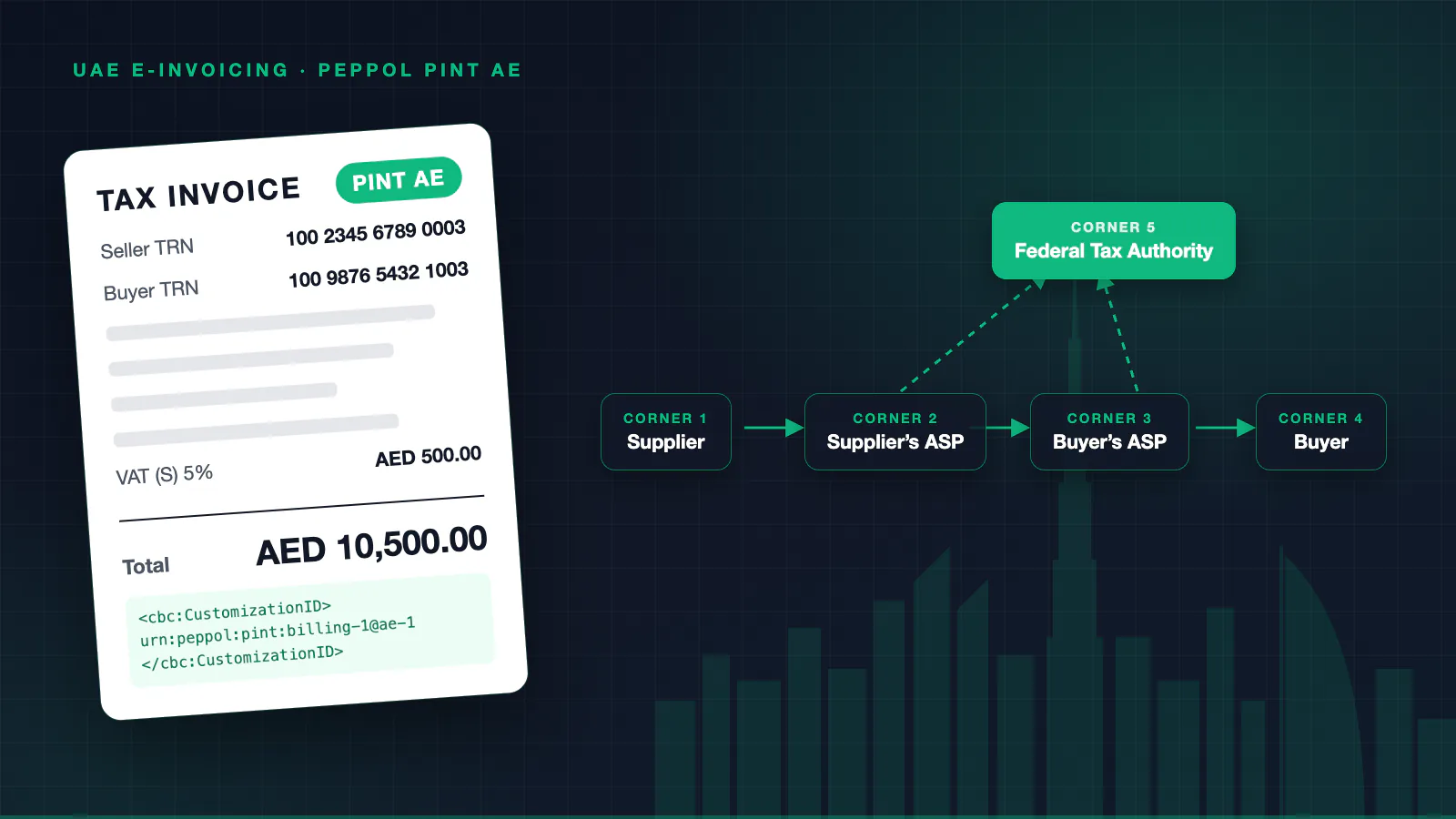
Invoices travel between Accredited Service Providers; tax data goes to the FTA.
Not sure how far your data is from PINT AE? Start with the assessment.
Tell us what your invoicing runs on and how many entities issue invoices. The data gap assessment is a fixed AED 2499 and gives you an honest read on the work between today and your deadline, credited against the build if you go ahead.
How it works
Five steps to go-live
For one modern ERP with a ready-made connector, this takes weeks. With several entities or a legacy system, allow a few months - which is why the assessment comes first.
Data gap assessment
We map every invoice type you issue against the mandatory fields and the PINT AE rules. This step decides the size of everything after it, so it comes first.
Choose your provider
We test shortlisted Accredited Service Providers’ integration options against your actual systems, so the provider you appoint is one your data can reach. You appoint it; we are not one of them.
Build the integration
Mapping, pre-submission validation and the connection itself, delivered in phases with a working test environment your finance team can see.
Test end to end
Every invoice type you really issue - credit notes, self-billing, exports, free zone supplies - goes through your provider’s test environment, not only a standard tax invoice.
Go live and monitor
We watch rejection rates daily for the first weeks, route exceptions to someone who can fix the source data, and confirm your archive is complete.
Where your invoices come from
A mainstream ERP or accounting package - SAP, Oracle, Microsoft Dynamics, Odoo, Zoho Books, QuickBooks, Tally, Sage - an older system with no provider connector, or operational software built in-house. If it holds the invoice data, we can complete it and map it.
Part of a wider operations practice
If the real problem is the system the invoices come out of, see our custom operations software service.
Based in the UAE? We work from Dubai, in your timezone and in Arabic or English - see our software development company in Dubai.
Assessment first
You see the gap before you commit to the build.
Fixed-cost proposal
A scope and a number, not an hourly meter.
You own the integration
Source code and documentation are handed over.
Based in Dubai
The assessment can happen in a room with your finance team.
Common questions
UAE e-invoicing questions, answered
What finance and operations teams ask us before an e-invoicing project.
Businesses with revenue of AED 50 million or more must appoint an Accredited Service Provider by 30 October 2026 and go live on 1 January 2027. Businesses below AED 50 million must appoint one by 31 March 2027 and go live on 1 July 2027. Government entities go live on 1 October 2027. Any business has been able to adopt the system voluntarily since 1 July 2026.
Something not covered here?
Get your invoices ready for PINT AE
Tell us what your invoicing runs on. You will get a field-by-field read on what is missing, a plan, and a fixed price - before your provider deadline.
Prefer to talk directly?
Assessment AED 2499. Builds from AED 15000. Full ownership. Based in Dubai.
