
Custom EHR Development: When to Build, Extend or Buy
A buyer’s guide for clinics and hospitals: when a custom EHR is worth building, what extending one involves, realistic timelines, and how to tell a healthcare software vendor from a general development shop.
By Felipe Bongiolo, WDF
Most healthcare organisations do not go looking for custom software because they want to build software. They go looking because something has stopped working - an EHR that needs six clicks for a task that should take one, a lab integration that quietly fails overnight, a scheduling system that cannot express how the clinic actually runs.
This is a practical guide to that decision, and above all to custom EHR development: when building is worth it, when extending your existing systems is the better answer, what HIPAA compliance costs in engineering terms, and how to tell a healthcare software vendor from a general development shop that has read a compliance checklist. If you already know you need a team to build it, start with our custom healthcare software development service.

A physician using a purpose-built app to access real-time patient data
Why off-the-shelf healthcare software stops fitting
Generic platforms are built to serve the average of thousands of practices, which means they fit almost none of them precisely. That is a reasonable trade when you are small. It stops being reasonable at the point where the workarounds cost more than the software.
- Workflow mismatch: Forced clicks, redundant fields and navigation designed around a data model rather than a clinical process. This is the most common reason clinicians describe an EHR as slowing them down.
- Interoperability gaps: The system cannot talk to your lab, your billing platform, your imaging provider or your telehealth tool without a manual export in the middle.
- Paying for modules you never open: Per-seat licensing on a platform where your team uses a third of the feature set.
- Change requests that go nowhere: A fix that matters enormously to you is a low-priority ticket on someone else’s roadmap.
- Reporting you cannot get at: The data exists but the vendor decides which questions you are allowed to ask of it.
None of these is an argument for replacing everything. Most are arguments for building the missing layer - which is a much smaller, cheaper and safer project. More on that below.
Custom EHR and EMR development: when it is worth it
This is the question we are asked most often, and the honest answer is that a full custom EHR is rarely the right first move. Certified EHR platforms carry years of regulatory work, and rebuilding that from scratch is a multi-year commitment most organisations should not make.
There are three genuinely different projects that all get called “custom EHR development”, and the difference in cost between them is roughly tenfold:
1. Extending an existing EHR
You keep the certified system of record and build the parts it does badly - intake, scheduling, care coordination, a patient-facing portal, a specialty module. Data flows both ways through the EHR’s API or through HL7 FHIR. This is the right answer for the large majority of clinics and hospitals, and it is where most of our healthcare work sits.
2. Building a purpose-built clinical system alongside it
A separate platform for something the EHR was never meant to hold - clinical staffing and rostering, home care visit verification, a device data pipeline, a research or trials workflow. It integrates with the EHR but is not trying to be one. This is where a custom build usually pays for itself fastest, because there is no incumbent doing the job at all.
3. Replacing the EHR entirely
Justified when you are a health service with genuinely unusual requirements, when you are building a product to sell to other providers, or when you operate in a jurisdiction where no certified platform fits your regulatory position. It is a serious undertaking and it should be entered with a multi-year budget and clinical leadership committed to it.
If you are weighing these against each other, our custom healthcare software development service starts every engagement with exactly this assessment, before anyone writes code.
Hospitals, clinics, private practices and home care: what differs
The word “healthcare” hides four quite different buying situations. What you need depends far more on the shape of your organisation than on your specialty.
- Hospitals and multi-site groups. The problem is almost never a missing feature - it is that eight systems hold overlapping copies of the same patient. Work here is integration, a unified operational view, and department-level tooling that the central EHR cannot economically provide. Clinical staffing and rostering is a recurring gap.
- Clinics and outpatient practices. The bottleneck is administrative load per clinician. Intake, insurance verification, recall and reminders, and a patient portal that people actually use. Highest return per pound spent of any category, because the workflows are well understood and the integrations are few.
- Private and specialty practices. Usually need one thing done extremely well - treatment planning, progress tracking against wearable or device data, outcome measurement. A narrow, deep tool beats a broad one.
- Home care and community providers. The hard problems are offline-capable mobile apps, visit verification, scheduling across a distributed workforce, and coordination between people who are never in the same building. Very poorly served by clinic-shaped software.
Custom home care software: what is different
Home care is the category where off-the-shelf clinical software fits worst, because it assumes a building, a desk and a network. A carer working in a patient’s home has none of those. Custom home care software development usually starts with four pieces:
- An offline-first carer app. The care plan, medication list and visit tasks are on the phone before the visit, and notes recorded without signal sync when it returns.
- Visit verification. Arrival and departure recorded against the scheduled visit, which is what payers and auditors ask for and what billing depends on.
- Scheduling across a distributed workforce. Skills, travel time and continuity of carer weighed together, with same-day changes pushed to the right phone.
- One record for the office and the patient file. Visit notes and observations reach the coordinators and the clinical record the same day, not at the end of the week.
A sensible first phase is the carer app and visit verification on their own: small enough to ship in a quarter, and it removes the paper that every later phase would otherwise have to work around.
What HIPAA compliance actually requires of your software
HIPAA is often discussed as though it were a certificate you obtain. It is not - the HHS Security Rule sets out required and addressable safeguards, and compliance is a property of how the system is built and operated. In engineering terms it means roughly the following, and each item costs real time:
- Encryption in transit and at rest, with a documented key management approach.
- Role-based access control that reflects real clinical roles, not three generic tiers.
- Audit logging of every read and write to protected health information - including reads, which teams routinely forget.
- Data residency decisions made deliberately, and a hosting provider that will sign a Business Associate Agreement.
- Breach notification procedures that exist before you need them.
- Minimum necessary access designed into the data model rather than enforced by policy alone.
Budget somewhere between fifteen and twenty-five percent of engineering effort for this on a healthcare project. A vendor who does not raise it unprompted is a vendor who has not costed it.
If you are in the UAE
HIPAA is a US law. Providers in the UAE build to different rules, and three of them shape the architecture from day one. Federal Law No. 2 of 2019 on the use of ICT in health fields requires health data from services provided in the UAE to be stored and processed inside the country unless an exception applies, which decides where the system is hosted. Facilities exchange records through their emirate’s health information exchange - NABIDH in Dubai, Malaffi in Abu Dhabi and Riayati in the Northern Emirates, which were linked to each other in 2023. And entities handling health information in Abu Dhabi must meet the Department of Health’s ADHICS standard.
If that is your position, our healthcare software development company in the UAE page explains how we build to those rules.
One further question worth settling early: if your software influences diagnosis or treatment, it may be regulated as a medical device. The FDA’s Software as a Medical Device guidance is the starting point, and the answer changes the project’s cost and timeline substantially. It is much cheaper to establish this in week one than in month nine.
HL7 and FHIR: what interoperability really involves
Interoperability is where healthcare projects most often run over budget, because “we have an API” and “we can exchange clinical data” are very different claims.
Older integrations typically speak HL7 v2 - pipe-delimited messages over a persistent connection, widely deployed and idiosyncratically implemented at every site. Newer work uses FHIR, which is a genuine REST API with defined resources and is far more pleasant to build against. In practice a real project involves both, plus at least one integration that turns out to be a nightly file drop nobody documented.
Three things to establish before anyone estimates the work:
- Which standard, and which version, each system actually speaks - not what the vendor’s marketing page says.
- Whether you can get a test environment. Integration work without a sandbox is the single most reliable cause of schedule overrun in healthcare software.
- Who owns the mapping. Two systems can both be FHIR-compliant and still disagree about what a field means. Somebody has to decide, and it should be someone clinical.
Integrating with Epic and other certified EHRs
Large certified EHRs such as Epic and Oracle Health (formerly Cerner) expose HL7 v2 interfaces and FHIR R4 APIs, so a custom application can read from and write to them like any other connected system. The code is rarely the slow part. Access to a test environment, approval from the EHR team and agreement on which data the application may touch are what set the schedule - so ask for all three before anyone gives you a date.
In the UAE there is usually a second interface to plan for: the emirate’s health information exchange. Facilities normally reach it through their EHR’s own connection, so a custom system that feeds the EHR correctly reaches the exchange too.
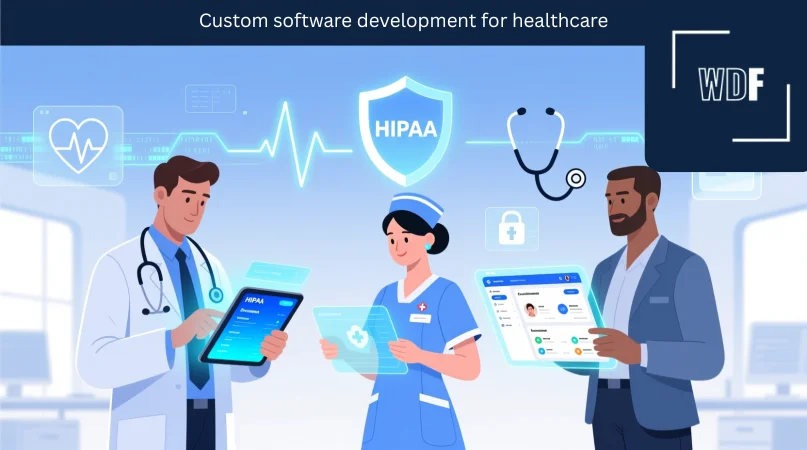
Automating repetitive tasks so clinicians can focus on care
How to evaluate a healthcare software vendor
Most development companies will say yes to a healthcare project. Comparatively few have shipped one. These questions separate them quickly, because they are difficult to answer convincingly without direct experience:
- “Walk me through how you handled audit logging on your last clinical build.” Specific, and impossible to bluff.
- “Which EHRs have you integrated with, and what broke?” The second half matters more. Everyone has integration war stories; only people who have done it have the right ones.
- “Who signs the Business Associate Agreement, and who is your hosting provider?” If this causes hesitation, they have not done this before.
- “How do you deploy without interrupting patient care?” Healthcare has no maintenance window. Look for phased rollout, parallel running, and a rollback plan.
- “Will clinical staff be involved in design, or only IT?” Software designed without the people who will use it is how you get a system that is technically correct and clinically unusable.
- “Do we own the code?” Some vendors retain ownership and license it back. Establish this before the contract, not after.
Timelines and budget bands
Vendors rarely publish these, which makes the whole category harder to buy from than it needs to be. Approximate bands from our own delivery experience - every project differs, and integration count is the single biggest driver:
- A single workflow tool (intake, recall, a patient portal, a scheduling layer): 6–10 weeks.
- A departmental platform with two or three integrations (staffing, care coordination, a specialty module): 3–6 months.
- A clinical operations platform spanning several departments: 6–12 months, usually delivered in phases that each go live on their own.
- A full custom EHR: multi-year. Treat any shorter estimate as a warning sign.
The most useful thing you can do to control cost is to reduce the number of systems the first phase has to talk to. Every integration adds not just build time but an external dependency you do not control.
Custom healthcare software: common questions
How much does custom healthcare software development cost?
It is set by scope rather than a price list, and three things drive it: how many systems the software has to integrate with, how much regulated data it handles, and whether you are extending a certified EHR or replacing one. Extending an existing EHR costs roughly a tenth of replacing it. Compliance work typically takes fifteen to twenty-five percent of the engineering effort. A reputable vendor should give you a fixed price after a short discovery phase rather than a range before it.
How long does custom healthcare software development take?
A single workflow tool such as intake, recall, a patient portal or a scheduling layer takes six to ten weeks. A departmental platform with two or three integrations takes three to six months. A clinical operations platform spanning several departments takes six to twelve months, usually in phases that each go live on their own. A full custom EHR is a multi-year programme.
Can custom software integrate with Epic or another certified EHR?
Yes. Large certified EHRs such as Epic and Oracle Health (formerly Cerner) expose HL7 v2 interfaces and FHIR R4 APIs, and a custom system reads from and writes to them like any other application. The technical work is rarely the slow part: access to a test environment and approval from the EHR team are what set the schedule, so ask for both before anyone estimates.
What does home care software need that clinic software does not?
It has to work where the care happens. That means a mobile app that keeps working without a connection and syncs later, visit verification that records when carers arrive and leave, scheduling and routing across a workforce that is never in one building, and care plans and visit notes that reach the office and the patient record the same day.
Which rules apply to healthcare software in the UAE?
Federal Law No. 2 of 2019 on the use of ICT in health fields requires health data from services provided in the UAE to be stored and processed inside the country unless an exception applies. Facilities exchange records through their emirate’s health information exchange - NABIDH in Dubai, Malaffi in Abu Dhabi and Riayati in the Northern Emirates. Entities handling health information in Abu Dhabi must also follow the Department of Health’s ADHICS standard.
Where to start
Start with the workflow that costs you the most, not the system that annoys you the most - they are frequently different. Scope a first phase that can go live on its own and prove value inside a quarter. Then expand.
We build custom healthcare software development projects for clinics, hospitals, home care providers and health services - from a single integration to a full clinical operations platform. Fixed-cost proposals, and you own the code at the end. If the right answer is to extend what you already have rather than build something new, we will tell you that.
Working through this decision now? and you will get an honest read on scope, sequence and cost - including whether a custom build is warranted at all.
How WDF does this in practice
This is work we do for clients every week. Here is what that looks like as a service:
