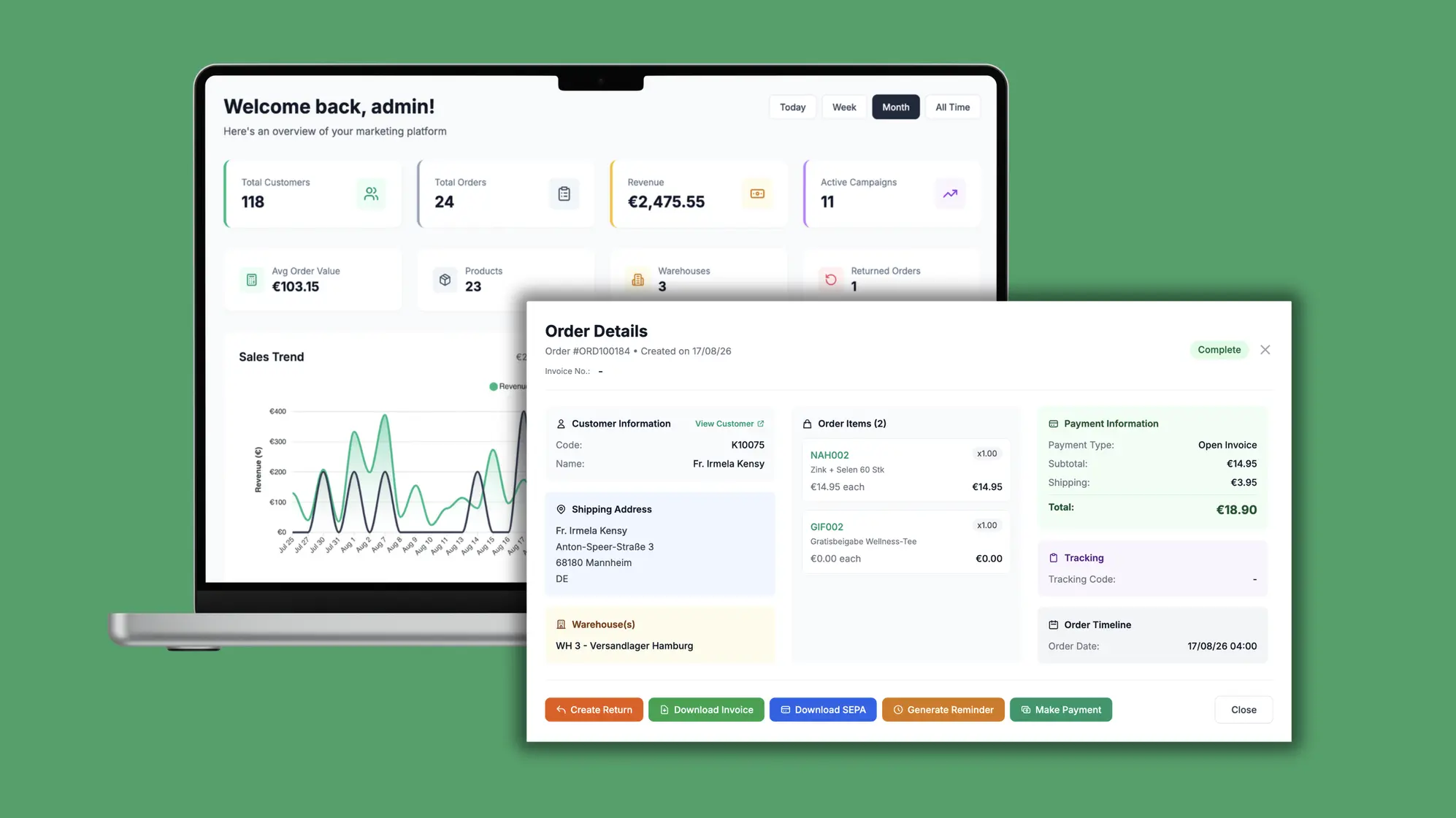
ERP Software Development
Custom ERP Software Development
One system for inventory, orders, invoicing and reporting, shaped around how your business trades. UAE VAT and e-invoicing are built in, and your data moves across without stopping work.
The problem
When the ERP runs the business
Most companies do not need a new ERP because the old one is broken. They need one because work has moved into spreadsheets around it.
The ERP fits the vendor, not you
Packaged ERP assumes a standard way of trading. When yours differs, staff work around the system with spreadsheets, and the spreadsheets become the real system.
Licences for people who do one task
Per-user pricing hurts most when drivers, warehouse staff or technicians each need a seat to do one thing. The bill grows with headcount, not with value.
The system is old and unsupported
It still works, so it never gets replaced. Every year of delay adds history to migrate and risk to the day it finally fails.
E-invoicing is coming in 2027
UAE invoices must be issued as PINT AE e-invoices through an Accredited Service Provider from 2027. A system that cannot produce clean structured invoice data needs work before then.
What we build
The modules your operation runs on
Built as one system, or as a custom layer connected to the accounting platform you already use.
Inventory & Warehouses
Stock levels in real time across warehouses and locations, with batches, transfers, returns and reorder points that match how you actually store and ship.
- Multi-warehouse stock
- Batches and expiry
- Reorder alerts
Orders, Sales & Purchasing
Quotes, orders, deliveries and purchase orders in one flow, so a sale updates stock, invoicing and reporting without anyone re-keying it.
- Quote to cash
- Purchase orders
- Customer and supplier records
Invoicing, VAT & E-Invoicing
Invoices generated from structured order data, with UAE VAT, credit notes and the data PINT AE requires, connected to your Accredited Service Provider.
- UAE VAT and TRN data
- PINT AE-ready invoice data
- ASP connection
Reporting & Dashboards
The numbers your team assembles by hand every month, live on a dashboard and exported in the format your accountant or bank expects.
- Live dashboards
- Scheduled reports
- Excel and PDF exports
Integrations
Keep the accounting platform your finance team trusts and connect it, along with e-commerce, shipping, payments and banking, through documented APIs.
- Zoho, Odoo, Xero, Business Central
- Shipping and payment APIs
- E-commerce sync
Migration From Your Old System
Years of transactions and stock moved across in validated batches, reconciled at each step, with both systems running side by side before cutover.
- Phased migration
- Parallel run
- No data loss
Case study
Replacing an unsupported ERP while the business kept running
Nutrisana Care ran inventory, billing and reporting on an ERP its vendor no longer supported. We mapped what it really did, migrated in reconciled batches and ran both systems in parallel before cutover.
25K+
automated invoices processed
110%
improvement in operational efficiency
Full
data retention through migration
Figures measured by the client after go-live.
Read the case studyNot sure whether you need a new ERP? Start with the map.
Tell us what your current system does and where the spreadsheets live. We will tell you whether to replace it, extend it or connect it, before anyone talks about budget.
Build, extend or integrate
A custom ERP is not always the answer
Three routes, and the one we recommend depends on your workflows and who needs a licence.
Packaged platform: Odoo, Zoho Books or Business Central, configured. Best when your processes are close to standard.
Hybrid: keep the packaged ledger for finance, and give operations staff a custom application with no per-user licence. Often the cheapest route for teams where many people do one task.
Custom ERP: one system built around your workflow. Best when the way you trade is your advantage and off-the-shelf software would flatten it.
Our guide to custom ERP versus Odoo, Zoho and Business Central compares published licence costs and the e-invoicing implications of each route. For internal tools that sit beside an ERP, see custom operations software.
How it works
Five steps from old system to new
Phased, so the business never stops and nothing moves until it has been checked.
Map the current system
We document what your current ERP, accounting tool or spreadsheets actually do, including the undocumented habits the business depends on.
Decide build, extend or integrate
Sometimes the right answer is a custom layer on top of Zoho or Odoo, not a new ERP. You get a recommendation with the trade-offs before any build is quoted.
Build in phases
The modules that remove the most manual work come first. You use a live preview from the first weeks, not a demo at the end.
Migrate and run in parallel
Data moves in validated batches. Old and new systems process the same transactions until the outputs match.
Cut over and hand over
Go-live, training and a support window, then the source code, documentation and deployment configuration are yours.
UAE e-invoicing
Replacing your ERP before 2027?
Whatever system issues your invoices has to produce PINT AE data and send it through an Accredited Service Provider. Businesses with revenue below AED 50 million must appoint a provider by 31 March 2027 and go live on 1 July 2027. A new ERP should be designed for that from the first invoice.
Why WDF
Engineers who migrate carefully
An ERP project fails at the migration, not the build. We plan the move first and design the system around it.
Based in the UAE? We work from Dubai, in your timezone and in Arabic or English - see our software development company in Dubai.
We have done the hard version
Our cloud ERP migration for Nutrisana Care moved years of history while staff kept working in the old system every day.
E-invoicing is our specialism
We build UAE e-invoicing integrations, so PINT AE is designed in from the start rather than bolted on before the deadline.
Honest about build versus buy
If a packaged platform with a few extensions fits, we will say so. Our guide to custom ERP versus Odoo, Zoho and Business Central sets out how we decide.
You own everything
Source code, documentation and deployment configuration are handed over. No per-user licence and no lock-in.
A team in Dubai
Workshops with your finance and operations teams can happen in the same room, in English or Arabic.
Mapped before it is quoted
A fixed proposal only after we understand the current system.
No data left behind
Reconciled batches and a parallel run before cutover.
Full IP ownership
Code, documentation and deployment are yours.
Reply within 24 hours
From an engineer, not a sales team.
Common questions
ERP questions, answered
What operations and finance teams ask before replacing an ERP.
We quote each ERP as a fixed price after mapping your current system, because the cost depends on how many modules you need, how many systems it connects to and how much history has to migrate. As a comparison point, packaged ERP licences are charged per user every month; our guide to custom ERP versus Odoo, Zoho and Business Central lists their published prices.
Something not covered here?
Ready to replace the spreadsheets?
Tell us what your business runs on today. You will get an honest recommendation and a fixed-price proposal, with no obligation to go ahead.
Prefer to talk directly?
Fixed-cost proposal. Full ownership. Based in Dubai.
